

What marks the artist is his power to shape the material of pain we all have.
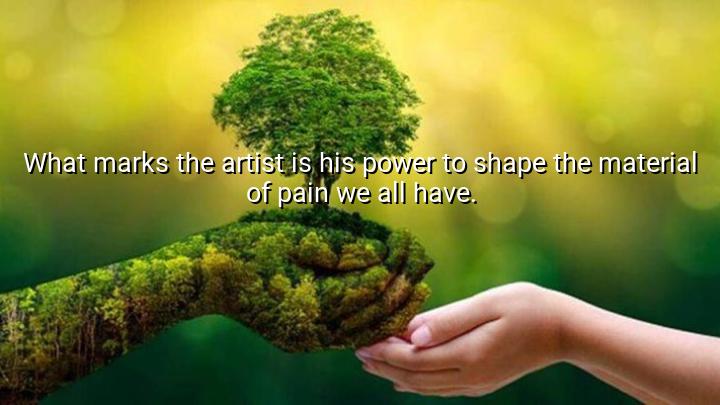




The quote "What marks the artist is his power to shape the material of pain we all have" by Lionel Trilling highlights the artist's ability to transform universal suffering or emotional experiences into something meaningful and expressive. Trilling suggests that artists are distinguished not just by their technical skills, but by their unique capacity to channel human pain—an emotion that everyone experiences—into their art. Through creativity, the artist can shape this often difficult and raw material, giving it form and purpose that resonates with others.
Trilling, a literary critic and philosopher, was deeply interested in the relationship between art and the human condition. He believed that art has a profound ability to reflect and address the emotional struggles that shape our lives. In this quote, he implies that artists engage with pain not as something to be avoided or ignored, but as a source of creative material that can be molded and interpreted into art. The emotional weight of pain becomes a tool for deeper exploration and understanding.
The origin of this quote comes from Trilling’s broader reflections on the purpose and power of art in society. Throughout his work, he discussed how art can serve as a mirror to the human condition, providing both a means of expression and a way of processing emotions. Trilling recognized that pain, in its many forms, is a universal experience, and artists have the unique ability to transform this raw material into something that speaks to the collective human experience.
For artists, this quote encourages the idea that pain is not something to shy away from but a vital part of their creative journey. It suggests that by confronting and shaping the emotional material of suffering, artists can create works that resonate deeply with others. Trilling’s words remind artists that their ability to channel personal and collective pain into powerful, expressive art is what sets them apart, allowing them to connect with others on a deeply emotional level.

LTLaf Tui
There’s a beautiful but haunting truth in this quote. It suggests that artists not only feel deeply but are also compelled to externalize that feeling for the sake of others. Could this be why so many artists report burnout or emotional exhaustion? I’d be interested to know if shaping pain into art is always a release—or can it also reopen wounds? And if it reopens them, does the art still serve its healing purpose?
JLJiiEun Lee
Is Trilling implying that artistry requires suffering? I find that idea both powerful and troubling. It makes me wonder: can we celebrate an artist’s work while fully acknowledging the pain behind it? Sometimes I feel guilty appreciating art if I know it came from deep emotional or psychological distress. How should we navigate that tension between admiring the product and empathizing with the process?
KNLe Thi Khanh Nhu
What strikes me about this quote is its suggestion that pain is a shared human material, but artists alone have the skill—or courage?—to mold it into something meaningful. I’d love to hear thoughts on whether this ‘shaping’ is a learned skill or an innate talent. Can anyone be taught to channel pain creatively, or is this ability what truly separates artists from the rest of us?
HN14_0150 Duong Hoai Ninh
This quote gives me mixed feelings. On one hand, it elevates the artist as someone uniquely capable of making sense of human suffering. On the other, it places a heavy emotional burden on them. Is it fair to expect artists to carry the collective weight of pain? It also makes me wonder if the audience has a responsibility to truly engage with that shaped pain—or are we just consuming it without understanding its origin?
NTNgoc Thi
Trilling's statement makes me think about the therapeutic aspect of art. If artists have the power to shape pain, are they also healing themselves and others in the process? I’m curious—do artists always consciously know they are channeling pain, or is it something that only becomes clear through reflection? And what happens when the pain is too raw—does the art become more or less effective in connecting with others?