

There is no connection between the political ideas of our educated class and the deep places of the imagination.
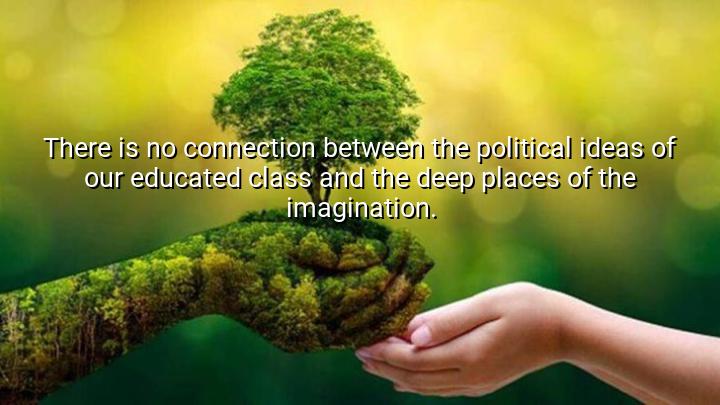




The quote "There is no connection between the political ideas of our educated class and the deep places of the imagination" by Lionel Trilling critiques the disconnect between intellectual or political thought and the emotional, creative depth that fuels human experience. Trilling suggests that the educated class, often concerned with logic, reason, and structured thought, tends to overlook the power of the imagination when forming or discussing political ideologies. In his view, political thought often lacks the emotional resonance and imaginative depth that would allow for more humane or compassionate policies.
By separating political ideas from the deep places of the imagination, Trilling highlights a tension between reason and emotion. While political discourse is often grounded in pragmatism, strategy, and intellectual frameworks, it may fail to address the more subjective, personal, and imaginative aspects of the human condition. The imagination, in this context, is not just about artistic creation but also about empathy, creativity, and understanding the broader emotional needs of society.
Trilling’s statement suggests that the educated class may be too focused on the abstract, intellectual aspects of politics, often ignoring the emotional and imaginative forces that shape human lives. This disconnect might lead to policies and ideologies that are out of touch with the real, lived experiences of individuals, particularly those outside of the intellectual elite. The imagination offers a way to consider the world more holistically, incorporating not just facts and figures but also emotional depth, empathy, and vision for a better future.
Ultimately, Trilling’s quote emphasizes the importance of bridging the gap between political ideas and the imaginative, emotional side of human existence. He calls for a more integrated approach where imagination and intellect work together to create a political landscape that truly reflects the complexities of human life and society.

AAdministratorAdministrator
Welcome, honored guests. Please leave a comment, we will respond soon