

What makes photography a strange invention is that its primary raw materials are light and time.
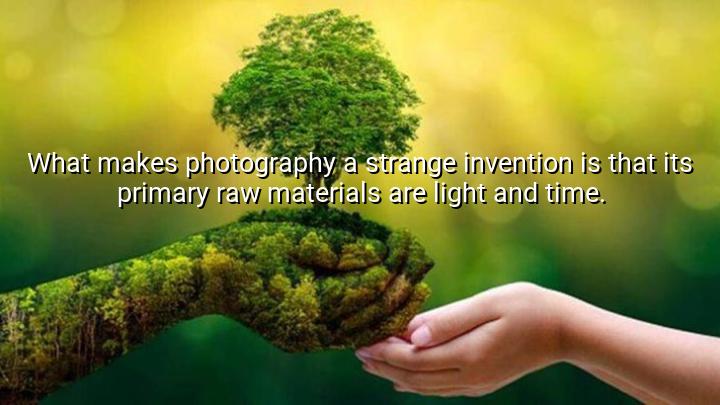




The quote "What makes photography a strange invention is that its primary raw materials are light and time" by John Berger highlights the unique and almost magical nature of photography as an art form. Unlike other forms of art, such as painting or sculpture, which rely on tangible materials like paint or clay, photography captures moments by harnessing the physical properties of light and time. Light is used to expose the subject onto the film or sensor, while time plays a crucial role in determining the duration of exposure, affecting the final image. These two elements work together to create a representation of reality that feels immediate and fleeting.
In this context, light and time are not just technical aspects but are fundamental to the very essence of photography. Light determines how an image is illuminated, how shadows are cast, and how details are revealed, while time influences the moment being captured. A photograph, therefore, becomes an intersection of these two factors: it freezes a specific moment in time while being shaped by the passage of that same time. This duality makes photography distinct from other forms of art, where the artist has more control over the final image or structure.
The origin of this quote lies in Berger's broader reflections on the nature of art and visual representation. As a renowned art critic and theorist, Berger often explored the relationship between images, their subjects, and their audiences, especially in works like Ways of Seeing. His insights into photography reflect his deep understanding of how the medium captures not just a visual representation but also an inherent temporality and changeability.
By stating that "What makes photography a strange invention is that its primary raw materials are light and time," Berger underscores how photography differs from traditional art forms. The use of light and time makes the process of photography both immediate and ephemeral, capturing the essence of a moment that can never be recreated in the same way. This relationship between light, time, and the captured moment gives photography a distinct power in documenting and interpreting the world.

GDGold D.dragon
There's something almost surreal about realizing that a photo is basically a record of time using light. It makes me think—are we capturing reality, or just the illusion of a moment? Berger's perspective blurs the lines between art and physics. And in a world flooded with images, have we become numb to just how mysterious and layered this 'invention' truly is? Maybe we need to start looking at photos a little more closely again.
UGUser Google
This quote makes me think about the scientific and emotional sides of photography. Light and time are measurable, but the feelings a photo can evoke are infinite. Is that contrast what makes photography so powerful? It’s technical at the core, yet profoundly human in its result. I also wonder: if photography is built on something as elusive as time, does that make every photograph a kind of visual memory or even a ghost?
KV9a4 Nguyen Khanh Vy
John Berger’s idea really challenges how we think about photography as a medium. It’s not paint or marble or even pixels—it’s light and time, two things that are constantly moving, changing, and never repeatable. That gives photography a kind of metaphysical depth. But does this also mean photography is more about observation than creation? Is the photographer an artist, or a collector of moments that already existed in nature?
HNHuyen Ngoc
This quote feels incredibly poetic. Light and time—two forces we can't hold or control—become the ingredients for capturing a moment forever. That really adds a layer of magic to photography for me. But I wonder: if those raw materials are so ephemeral, does that mean every photo is inherently an illusion? Or does the image gain truth through its ability to freeze what otherwise would be lost forever?
LMme la me
Isn’t it fascinating that photography depends on two intangible elements—light and time? It makes me think about how fragile and fleeting a photo really is. You’re freezing a particular arrangement of light that will never exist in quite the same way again. Does that make photography more authentic or more artificial than other art forms? Berger’s quote makes me view even casual snapshots with a bit more awe and philosophical weight.