

What is forgiveness? An emotion? A coping mechanism? An element of deepest faith? A way for the heart and soul to combat the type of hate, anger, rage and a thirst for revenge that could ultimately consume a person? All of those and more?
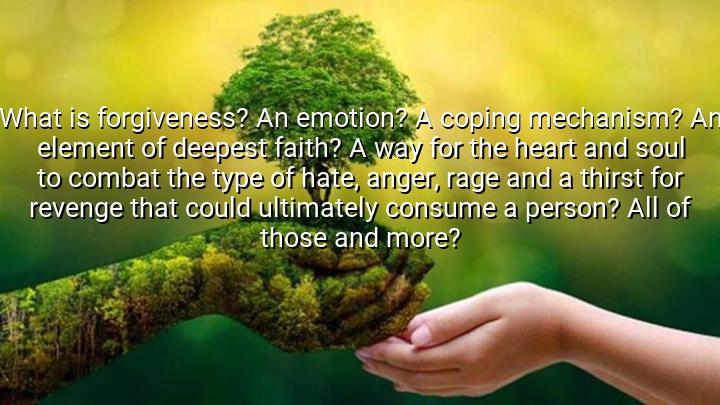




In this quote, Mike Barnicle explores the complex and multifaceted nature of forgiveness. He raises questions about whether forgiveness is an emotion, a psychological coping mechanism, or a manifestation of deepest faith. Barnicle challenges the simplicity of defining forgiveness, suggesting that it may encompass many layers and meanings depending on the context in which it is experienced.
Barnicle also links forgiveness to the human struggle with hate, anger, rage, and a thirst for revenge—all of which can have a destructive impact on an individual. He proposes that forgiveness can be a tool for combating these negative emotions, which, if left unchecked, could consume a person and prevent them from healing or moving forward. By framing forgiveness in this way, Barnicle highlights its potential to protect the heart and soul from the corrosive effects of unresolved anger.
The quote reflects the internal conflict many people face when dealing with hurt or betrayal. It emphasizes the importance of forgiveness not just as a way to excuse or forget wrongdoings, but as a conscious choice to free oneself from the heavy burden of resentment and hatred. Barnicle implies that the act of forgiving can provide emotional and spiritual relief, allowing individuals to rise above their negative emotions and find peace.
Ultimately, Barnicle’s quote invites reflection on the nature of forgiveness as a deeply transformative process that involves more than simply letting go—it requires emotional and spiritual strength. His words suggest that forgiveness is not only a response to the harm caused by others but also an essential part of maintaining inner peace and avoiding the self-destructive path of vengeance.

HHHuy Huynh
I appreciate the way this quote questions the nature of forgiveness—it feels less like a command and more like an invitation to reflect. But I wonder: does forgiveness have to be final and complete, or can it be partial, revisited, even imperfect? In real life, especially with deep trauma, isn’t it more of a process than a moment? That possibility gives me hope.
TLPhan Tan Loc
The idea that forgiveness combats hate and rage is compelling—but does that make it a form of strength or a kind of surrender? I’ve heard people say that forgiveness frees the forgiver, but I’ve also seen people weaponize that message to silence legitimate anger. How do we ensure that forgiveness is empowering, not just something used to suppress necessary emotional expression?
TVDuong Thao Vy
This made me think about the relationship between forgiveness and identity. For some, it’s tied to faith; for others, it’s a personal moral code. Is there a universal form of forgiveness, or is it always shaped by our upbringing, culture, and beliefs? I’d love to explore whether people from different backgrounds experience and define forgiveness in the same way—or if it’s entirely relative.
SHStart Hope
Barnicle’s framing of forgiveness reminds me of how personal and spiritual the act can be. But I’m left wondering—can forgiveness exist without justice? If someone forgives a deep wrong without any accountability from the other side, does that change the nature of what forgiveness is? I struggle with this tension between internal peace and external fairness.
BBBum Bummm
I love how this quote frames forgiveness as something multidimensional, but it also raises a hard question for me—what happens when forgiveness feels impossible? When the pain is too deep, or the offense ongoing? Is forgiveness still expected or even healthy in those situations? Sometimes I worry we pressure people to forgive before they’re truly ready, just to keep the peace or meet cultural expectations.