

What I wish to show when I paint is the way I see things with my eyes and in my heart.
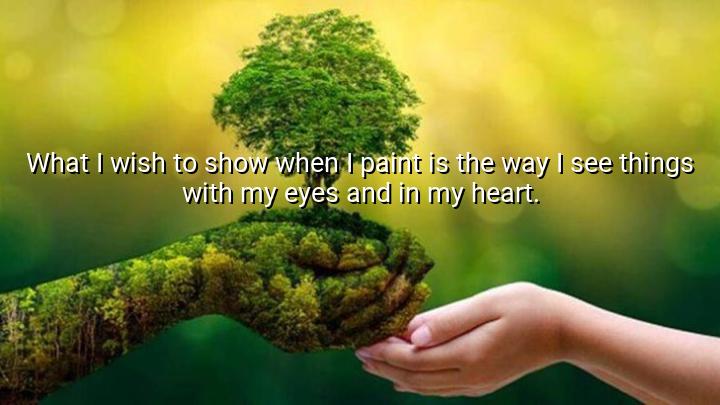




The quote "What I wish to show when I paint is the way I see things with my eyes and in my heart" by Raoul Dufy reflects his desire to express both the visual and emotional aspects of the world through his art. Dufy, a French painter known for his vibrant and colorful works, believed that art should not only depict what is physically visible, but also convey the artist's emotional response and inner experience. By combining what he saw with his eyes and what he felt in his heart, Dufy aimed to create a more holistic representation of reality that captured both its external beauty and its emotional resonance.
Dufy’s statement emphasizes the idea that art is not just a mechanical process of reproduction, but a deeply personal and emotional act. The integration of both the visual and the emotional aspects of perception reflects the notion that art is a way of communicating subjective experiences. For Dufy, the act of painting was a way to share his unique perspective on the world, inviting viewers to see not only what he saw but also to feel what he felt.
This approach is seen in Dufy's work, which often features bright, bold colors and fluid, expressive lines. His paintings are filled with energy and life, capturing the joy and movement of the world around him. By prioritizing both the physical appearance and the emotional impact of his subjects, Dufy sought to create art that resonated on multiple levels, engaging the viewer both visually and emotionally.
Ultimately, Dufy’s quote reflects the dual role of the artist—to observe the world and to respond to it emotionally. His art was a blend of personal interpretation and objective observation, showing that true art is not just about what can be seen, but also about the feelings and experiences that come with it. Through his work, Dufy sought to bridge the gap between the external world and the internal landscape of the artist’s heart.

Nnpt
This quote speaks to the essence of personal vision in art. It makes me want to ask: is this approach universal to all artists, or is it more characteristic of expressionists like Dufy? Some artists might focus more on technique, symbolism, or narrative rather than personal feeling. I’d be interested in exploring how different movements interpret this idea of painting from both the eye and the heart. Is one more ‘authentic’ than the other?
BPTran Bao Phu
There’s something beautifully simple about this quote, but I think it’s deceptively deep. It makes me think about the connection between perception and emotion—how our feelings shape what we notice, and vice versa. Does this mean that every painting is essentially autobiographical in some way? Even a landscape? I wonder how much of the artist's identity is always embedded in the work, even when it’s not overtly personal.
NDAn Nguyen Do
I admire the sincerity here. But it also raises the question: what happens when what someone sees with their eyes and feels in their heart is in conflict? How does an artist resolve that tension on the canvas? Can both elements coexist without one overpowering the other? I’d love to know how Dufy balanced visual accuracy with emotional resonance in his own process—it seems like a complex balancing act.
GB8C Gia Bao
This statement makes me curious about the artist’s responsibility to the viewer. If someone paints how they feel and see, is it still their job to make it understandable to others? Or is it enough to just be authentic? I sometimes struggle with abstract or emotionally driven art—does that mean I’m missing the point? Maybe it’s less about 'getting it' and more about being open to someone else’s experience.
KKhoa
I love the vulnerability in this quote—it sounds like Dufy isn’t just trying to represent the world but to translate his inner life. But it also makes me ask: can viewers ever really access an artist’s heart just by looking at their work? How much of what we ‘see’ in art is shaped by our own perceptions rather than the artist’s intent? Is art communication or interpretation—or both?