

My eyes were made to erase all that is ugly.
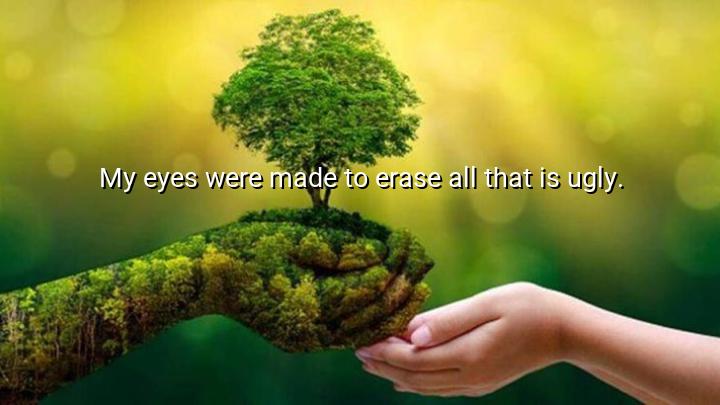




The quote "My eyes were made to erase all that is ugly" by Raoul Dufy speaks to the artist's perception of the world and his role in transforming it through art. Dufy, a French painter and designer known for his vivid, colorful works, suggests that his eyes are not simply for observing reality but for interpreting and reshaping it. He sees art as a way to filter the world, focusing on beauty and joy while eliminating the negative or the unpleasant. In this sense, Dufy’s eyes serve as a tool for elevating the world around him, helping him create works that highlight harmony, beauty, and color.
Dufy's statement also reflects his approach to art, which often focused on cheerful, idealized scenes rather than realistic or harsh depictions of everyday life. His work in fauvism and post-impressionism embraced bright colors and simplified forms, intentionally avoiding the grittier, darker aspects of life in favor of uplifting and aesthetically pleasing subjects. The idea that his eyes were made to "erase" the ugly speaks to his desire to reflect a world filled with light, joy, and positivity.
This quote suggests that art for Dufy was not merely a representation of reality, but an idealized version of it. He believed that through the lens of art, he could remove the discord and negativity that often accompany real life, offering viewers a glimpse of beauty and serenity. For Dufy, the purpose of art was to improve and elevate human experience, helping people see the world in a more positive light.
Ultimately, Dufy’s words encapsulate his artistic philosophy: the idea that art is a way to cleanse and enhance the world by focusing on what is beautiful and uplifting, rather than confronting the ugly aspects of life. Through his work, he aimed to offer an escape from the harshness of reality, allowing his audience to experience a more harmonious and joyful vision of the world.

TITuyet Ice
This quote makes me wonder whether Dufy saw beauty as a tool for healing or escapism. Was he trying to inspire people to look beyond the surface and find grace in everything? Or was he avoiding reality by focusing only on what pleased him visually? Can art still be meaningful if it ignores the darker parts of life, or does its power come from how it wrestles with both the beautiful and the broken?
VVankedisi
There’s something both comforting and unsettling about this quote. On one hand, it celebrates the power of beauty and the artist’s unique vision. On the other, it seems to dismiss or reject the real struggles that shape the human experience. I’m curious—does striving to 'erase ugliness' risk invalidating important stories or truths that need to be told, even if they’re unpleasant or disturbing?
NHNguyen Hoa
Dufy's statement makes me reflect on how we each curate our version of reality. Is he talking about editing the world through artistic interpretation, or literally refusing to acknowledge the existence of ugliness? That distinction matters to me. In a time when social issues need visibility, can we afford to ‘erase’ what’s ugly? Or is he suggesting a form of resistance—fighting back with beauty when the world feels bleak?
HHaki
I find this quote really inspiring. It makes me think about the role of the artist as someone who filters reality—almost like a translator who converts pain, mess, or chaos into something we can bear or even love. But do you think this perspective could limit artistic expression? Some of the most impactful works I've seen don’t erase ugliness—they confront it. Where’s the line between beautifying and sugarcoating?
HNThao Huyen Nguyen
Dufy’s quote feels almost utopian, like he saw the world through a lens of optimism and aesthetic idealism. But I wonder—what defines 'ugly' to him? Is it visual unpleasantness, moral decay, suffering? The subjectivity here fascinates me. Could his desire to erase ugliness be seen as a form of denial, or is it a powerful statement about creating hope and beauty despite the world’s flaws?