

What I didn't know was I was deeply attracted to the big space.
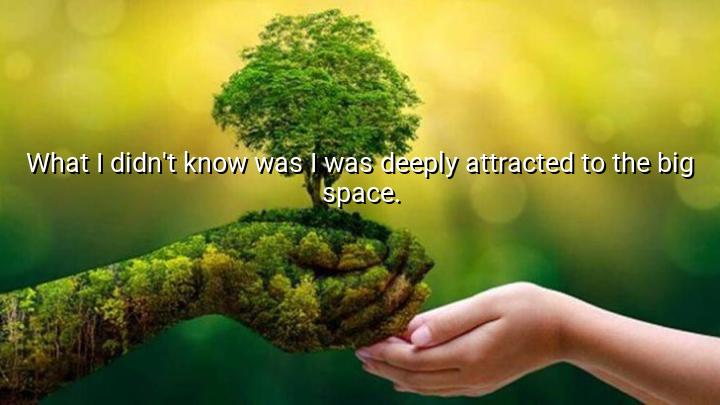




The quote "What I didn't know was I was deeply attracted to the big space" by David Hockney reflects his growing fascination with the concept of space in art. Hockney, known for his innovative approach to perspective and his exploration of the physicality of space in his work, suggests that his attraction to large, open spaces influenced his artistic evolution more than he initially realized. The space here can be interpreted both literally and metaphorically—Hockney may be referring to the physical space within his paintings, as well as the emotional or intellectual space that he sought to explore and convey in his art.
Hockney, a renowned British artist, often played with perspective, challenging traditional notions of how space and depth are represented in two-dimensional art. His interest in space can be seen in his famous works, where he experimented with multiple viewpoints and large-scale canvases. This quote underscores how his work was shaped by a subconscious draw toward spaces that allowed for greater freedom and exploration, both in terms of composition and personal expression.
The origin of this quote stems from Hockney’s own reflection on his artistic journey and his evolving understanding of the importance of space. Over the years, Hockney moved from more traditional forms of painting to experimental work, including photographic collages and perspective experiments, which allowed him to engage with space in new and dynamic ways. This newfound awareness of his attraction to space highlights his openness to exploring how it can transform an artwork, both visually and conceptually.
For artists, this quote invites reflection on how space—whether physical or emotional—shapes their creative process. It suggests that the spaces we are drawn to in our lives and work can significantly influence the direction of our art. Hockney’s words encourage artists to consider how they engage with the concept of space in their work, whether they are aware of it or not, and how it can be used as a tool for greater expression and discovery.

TSThai Son
This quote made me stop and think—what is my 'big space'? It’s interesting how Hockney seems to reference both an external environment and an internal longing at the same time. Do all artists have a version of that—a space or subject they’re innately pulled toward without understanding why at first? Maybe that’s where true originality comes from: not planning, but responding to a calling we didn’t even hear at first.
HDHuyen Dao
What strikes me is the quiet vulnerability in this quote—it’s not just about physical space, but maybe about coming to terms with one's own desires and fascinations. How often do we realize after the fact what truly moves us? I feel like Hockney is offering an example of how self-awareness can evolve through making art. It’s not just about expressing what we know, but discovering what we don’t.
VVVinh Vlog
I keep thinking about how artists respond to physical space. For Hockney, it sounds like the vastness of the environment itself was a kind of muse. Could this be why so many artists travel or move to new landscapes when they feel stuck? I’d be curious to know what specific 'big space' he’s referring to and how that influenced his visual style. It makes me want to examine his large-scale works again with this in mind.
LNLe Nga
There's something really compelling about how Hockney frames discovery—almost like he stumbled into a truth about himself through his work. Is that what all great artists do, uncover truths they didn’t know they were chasing? I wonder how often we’re creating or doing things that fulfill needs we haven’t even articulated yet. It's a reminder to follow your intuition, even if you don’t fully understand it in the moment.
DBKiet Dang Ba
I find this quote really intriguing, especially the phrase 'didn’t know.' It highlights the idea that our artistic preferences can emerge instinctively. Do you think all artists are in some way led by these unconscious leanings? Also, what do you think 'big space' represents here—landscape, scale, freedom, or something more spiritual? It seems like such a personal yet universally resonant idea.