

The moment you cheat for the sake of beauty, you know you're an artist.
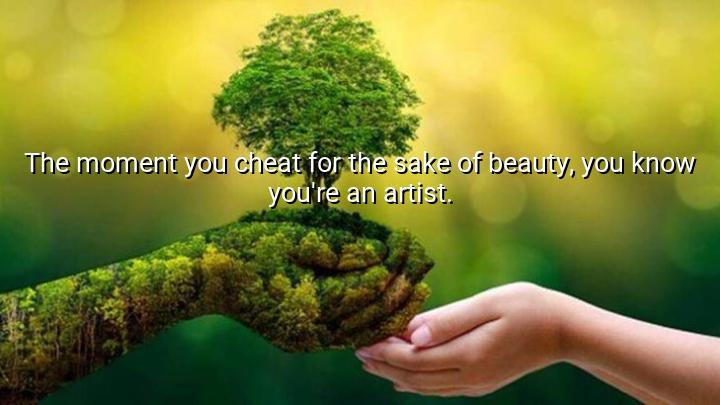




The quote "The moment you cheat for the sake of beauty, you know you're an artist" by David Hockney speaks to the idea that art often involves bending or breaking rules in order to achieve a higher aesthetic goal. Hockney is suggesting that an artist, in their pursuit of beauty, may sometimes have to take liberties with reality or conventional methods, consciously altering things to enhance the visual or emotional impact of their work. The "cheating" refers to the manipulation or distortion of the truth in a creative way, which ultimately serves the artistic vision.
In this context, beauty is not just about external appearances but refers to the deeper, more emotional or intellectual qualities that an artist seeks to convey. Hockney implies that art is not about adhering strictly to reality or rules, but about using imagination and creativity to find a new, often more compelling way to represent the world. By saying that cheating for the sake of beauty defines an artist, he is acknowledging that creative freedom often requires bending the norms or expectations to convey something more profound or engaging.
The origin of this quote comes from David Hockney's own approach to art. As a renowned British artist known for his work in painting, drawing, and photography, Hockney has long challenged conventional boundaries in art. His works often explore the relationship between perspective, space, and color, using unconventional techniques to create something fresh and visually striking. His statement reflects his belief that the role of an artist is not merely to replicate what is seen but to interpret and transform it into something unique and beautiful.
By stating that "The moment you cheat for the sake of beauty, you know you're an artist," Hockney is acknowledging that creativity often involves defying the rules in service of a greater goal. This quote invites artists to embrace freedom in their creative process, recognizing that art can be about taking risks and using imagination to push beyond what is expected, ultimately leading to something that resonates deeply with the viewer.

Ssims
This quote challenges conventional ideas about honesty and beauty in art. It suggests that manipulation isn't just acceptable, it's necessary. But isn’t there a danger in normalizing 'cheating' as part of the creative process? Could this mindset be used to justify cultural appropriation, plagiarism, or misrepresentation in the name of aesthetics? I’d love to hear how artists themselves interpret this—whether it’s liberating or ethically murky.
KLKhanh Lam
Hockney’s quote makes me wonder if all art is a form of illusion. If making something more beautiful than it is means you're an artist, does that mean ugliness—or brutal honesty—disqualifies you from that title? Or is there artistry in exposing harsh truths as well? It's an interesting paradox: do artists become artists by enhancing reality, or can they do so by refusing to embellish it too?
LCLe thi Linh Chi
I love how this quote elevates the role of artistic license. It implies that artists have permission—almost an obligation—to reshape reality in order to reveal a deeper, perhaps more poetic, truth. But then, where does this leave technical accuracy or realism? Are they less valid forms of art, or just different? It opens up a great conversation about whether emotional truth matters more than factual accuracy in creative work.
NMNgan Minh
There’s something almost rebellious about Hockney’s statement. It feels like a justification for breaking the rules in the name of expression. But does that mean artists are inherently liars, or just selective truth-tellers? I'm torn—on one hand, I respect the creative license; on the other, I wonder if some audiences might feel misled. Is beauty always worth that tradeoff, or should there be limits to this 'cheating'?
THHA TRI HUNG
I find this quote kind of cheeky but also deeply thought-provoking. It suggests that bending the truth in pursuit of beauty isn't a flaw but a defining trait of artistry. But doesn’t this raise questions about authenticity? Can a piece still be considered truthful if it's intentionally distorted for effect? I’m curious how this applies to things like documentary photography or realistic portraiture where 'truth' is expected.