

We're taught to be ashamed of confusion, anger, fear and sadness, and to me they're of equal value to happiness, excitement and inspiration.
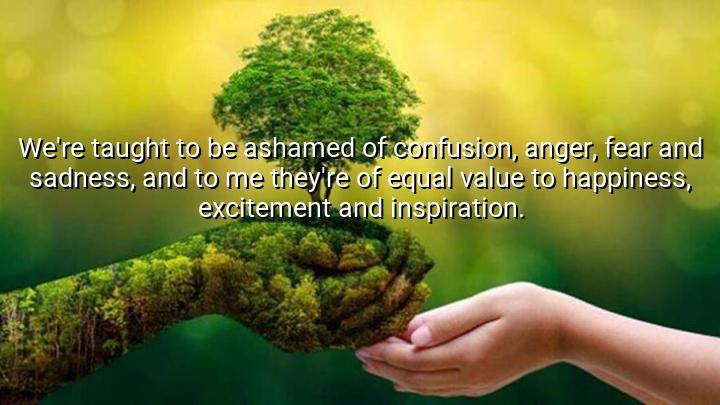




In this quote, Alanis Morissette highlights how society often teaches us to hide or suppress certain emotions like confusion, anger, fear, and sadness. These feelings are frequently seen as negative or undesirable, leading many people to feel ashamed or uncomfortable when experiencing them. Morissette challenges this view, suggesting that these emotions are just as important and valuable as more traditionally positive feelings like happiness, excitement, and inspiration.
The idea that we should only embrace "positive" emotions while shunning the so-called "negative" ones creates an emotional imbalance. Morissette's quote encourages us to accept all aspects of our emotional experience, seeing them as equally valid and human. By doing so, we can allow ourselves to grow and understand our emotions more deeply rather than suppress them out of shame.
The origin of this perspective may stem from Alanis Morissette's own journey of personal and artistic expression, where she has been open about navigating through her complex feelings. As a renowned singer-songwriter, she has consistently used her music to explore a wide range of emotions, making her quote a reflection of her own approach to emotional honesty. She reminds us that embracing all emotions, not just the positive ones, can be a path to true self-acceptance.

NPThu ngan Pham
Alanis Morissette’s quote challenges cultural norms around emotional expression. I’m curious about how different societies handle this—are there cultures that naturally value all emotions equally? How does this affect people’s well-being and communication? It also raises the question of how media and education might shift to promote a more balanced view of our emotional lives.
PMpham minh
This statement highlights a crucial imbalance in emotional awareness. If emotions like anger and fear are treated as equal to joy and excitement, could this lead to greater self-compassion? I wonder how this idea intersects with therapy and mindfulness practices that emphasize acceptance and non-judgment of feelings. It feels like a call to broaden our emotional vocabulary and acceptance.
ADAnh Dao
Reading this quote makes me reflect on emotional education. Are we taught anywhere that sadness or confusion has inherent worth? How different would childhoods be if children were encouraged to explore all emotions fully? It seems like this approach could reduce the pressure to ‘perform’ happiness and foster more authentic self-expression.
TThoa
I find this perspective refreshing yet challenging. It’s easy to celebrate happiness but harder to be open about fear or anger without feeling judged. How can we create environments, both personally and culturally, where all emotions are accepted without shame? Does this acceptance change how we process difficult experiences or support others going through them?
GDGold D.dragon
This quote really resonates with me because it challenges the stigma around so-called ‘negative’ emotions. It makes me question why society often encourages us to hide feelings like confusion or sadness instead of embracing them as equally important. Could accepting these emotions as valuable help us develop emotional resilience? How might this shift impact mental health and interpersonal relationships if normalized?