

Were I called on to define, very briefly, the term Art, I should call it 'the reproduction of what the Senses perceive in Nature through the veil of the soul.' The mere imitation, however accurate, of what is in Nature, entitles no man to the sacred name of 'Artist.'
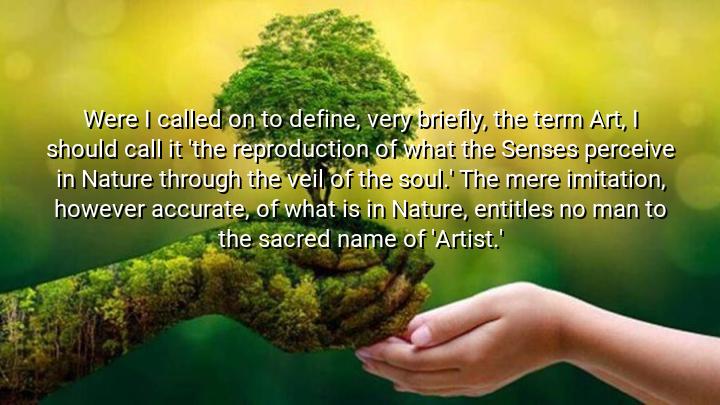




The quote "Were I called on to define, very briefly, the term Art, I should call it 'the reproduction of what the Senses perceive in Nature through the veil of the soul.' The mere imitation, however accurate, of what is in Nature, entitles no man to the sacred name of 'Artist.'" by Edgar Allan Poe presents a nuanced definition of art that emphasizes its deeper, emotional, and spiritual qualities. Poe, a master of poetry and prose, argues that art is not simply about accurately copying what is seen in the physical world (Nature), but rather about capturing the essence of that world through the soul of the artist. According to him, the true artist must go beyond mere imitation to express something deeper and more personal.
Poe’s quote highlights the role of the soul in the artistic process. He suggests that art involves not just visual or sensory reproduction but also an emotional or intellectual interpretation of what is perceived in Nature. The artist must filter their observations through their soul, imbuing the work with personal insight, emotion, and meaning. This means that an artist’s work should reflect their unique perspective, emotional resonance, and deeper understanding of the world around them, rather than simply mimicking nature.
The quote also critiques the idea that accurate representation alone qualifies someone as an artist. For Poe, the mere act of copying or imitating nature does not make one a true artist. True art transcends simple replication and brings something new to the table—whether it is emotional depth, conceptual richness, or a unique perspective. This distinction elevates art beyond technical skill, aligning it with creativity, innovation, and personal expression.
In essence, Poe’s quote emphasizes that art is not just about external representation but about capturing the deeper truth and essence of life as filtered through the soul. A true artist, then, is one who brings personal insight and emotional depth to their work, going beyond mere imitation to create something that resonates on a more profound, spiritual level.

TTLE THANH TRUNG
Poe’s perspective is incredibly romantic—and maybe that’s the point. He’s elevating art to something sacred, almost mystical. But does that romanticism exclude more modern or conceptual forms of art that might not rely on nature or the senses at all? What about abstract art that doesn't 'reproduce' anything perceivable? This quote raises questions about whether Poe’s view is timeless or rooted in his own era’s aesthetics.
MHNguyen Le Minh Hoang
I love how Poe draws a line between imitation and transformation. It speaks to the idea that art is not passive, but a deeply active, interpretive process. That said, isn’t there also beauty in pure replication? Scientific illustration, for example, requires immense precision but can still move the viewer. So where do we draw the line? Does the intention behind the work matter more than the method?
TNTran Ngov
This quote reminds me of the debate between technique and expression in art education. Poe seems to argue that technical mastery isn't enough—it’s the emotional or spiritual filter that transforms perception into art. But how do we teach or measure that? Can a soul’s influence be developed, or is it something intrinsic? This makes me think a lot about how we evaluate creativity and talent in general.
DNDuy Nguyen
There’s something really poetic in the idea that art is filtered through the soul. It implies that every artist is offering a unique interpretation of nature, not just a visual copy. But I wonder, does this make hyperrealistic or photorealistic art less valuable? If an artist pours themselves into perfect imitation, can’t that also be soulful? Maybe Poe’s idea works better metaphorically than as a strict standard.
TDDo Thanh Dat
Poe’s definition sets a pretty high bar. It’s almost intimidating. He’s saying that unless your work carries personal, internal depth, you’re not really an artist. But isn’t there room in art for craft, tradition, or even playfulness? What about highly realistic sculpture or classical portraiture—are those not art if they don’t include this 'veil'? It feels a bit rigid, though I admire the passion behind it.