

A strong argument for the religion of Christ is this - that offences against Charity are about the only ones which men on their death-beds can be made - not to understand - but to feel - as crime.
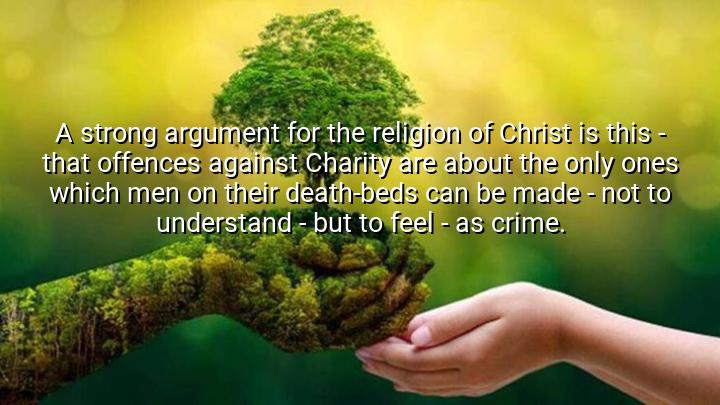




The quote "A strong argument for the religion of Christ is this - that offences against Charity are about the only ones which men on their death-beds can be made - not to understand - but to feel - as crime" by Edgar Allan Poe reflects on the moral and spiritual power of Christian teachings, particularly the principle of Charity. Poe suggests that, when faced with the end of life, people often become deeply aware of the moral implications of their actions. Offences against charity—meaning actions that harm others or lack compassion—stand out in one's conscience as particularly grave, as they are not just understood rationally but are deeply felt as wrongdoing at the time of death. This underscores the idea that compassion and kindness are at the heart of Christian values and, in the face of mortality, they hold a powerful moral weight.
Edgar Allan Poe, a master of Gothic literature and poetry, often explored themes of guilt, mortality, and the human condition. His works, such as "The Tell-Tale Heart" and "The Fall of the House of Usher," delve into the darker aspects of the human psyche. In this quote, Poe points to the redemptive and transformative power of the Christian faith, highlighting that, even in moments of ultimate reckoning, the idea of Charity—defined as love, compassion, and selfless service—is deeply felt and acknowledged as a guiding principle in life and death.
The origin of this quote lies in Poe’s broader reflection on morality and spirituality. While he is often known for his dark and unsettling works, Poe's understanding of Christian doctrine reflects an awareness of the power of charity in human life. He saw it as a uniquely redemptive force, capable of elevating the human soul. In particular, he believed that Charity had the ability to profoundly affect a person’s sense of guilt and responsibility, especially when facing death. By linking Charity to feelings of crime and remorse in one's final moments, Poe underscores the urgency of living a compassionate life.
Ultimately, the quote serves as a reminder that, in the final moments of life, we may not only reflect on our actions but feel the moral consequences of those actions. Poe suggests that Charity—the act of caring for others selflessly—is so vital that, on a deathbed, it transcends intellectual understanding and becomes an undeniable emotional truth. The quote advocates for a life lived with compassion, urging us to prioritize kindness and empathy over the fleeting concerns of the material world.

AAdministratorAdministrator
Welcome, honored guests. Please leave a comment, we will respond soon