

We need all races of men, and decent women, to stand up for what's right, drop anger, and live upright.
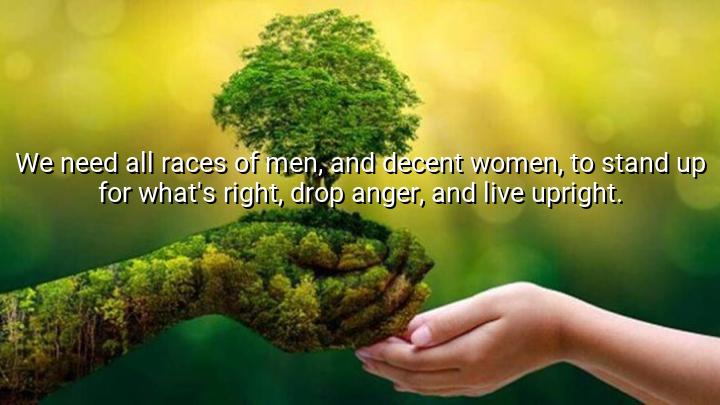




The quote "We need all races of men, and decent women, to stand up for what's right, drop anger, and live upright," by Jesse Lee Peterson, emphasizes the importance of unity, moral integrity, and emotional control in the face of societal challenges. Peterson, a conservative commentator, calls for people of all races and genders to come together to uphold what is morally right, suggesting that social change begins with individual responsibility and collective action. He stresses that the solution to many of the problems society faces lies in people choosing to act with integrity and rejecting negative emotions like anger.
In this quote, Peterson underscores the idea that anger can be a hindrance to personal growth and societal progress. Instead of being driven by negative emotions, he advocates for the pursuit of an upright life, where individuals take responsibility for their actions and strive to make positive contributions to their communities. The call to "drop anger" suggests that anger can cloud judgment and prevent meaningful progress, and that letting go of it can lead to better decision-making and harmonious relationships.
The mention of "decent women" indicates that Peterson values moral integrity not just in men, but in women as well. By using the word "decent," he implies that the women he refers to are those who live by high ethical standards and contribute positively to society. This emphasis on decency further reinforces his message that living upright is a shared responsibility for everyone, regardless of their gender or background.
Ultimately, Peterson's quote calls for collective action based on moral values and emotional maturity. By advocating for all people to drop anger and live upright, he promotes the idea of building a better society through individual responsibility and unity. His message encourages people to transcend division and work together to create a more just and peaceful world.

Ttrandinhtheanh
Peterson’s call for unity and upright living is inspiring, but I’m curious about how this can be practically achieved across diverse communities with varied histories and struggles. Can all groups agree on what ‘what’s right’ means? And is it realistic to ask people to ‘drop anger’ without addressing the causes of that anger? This quote opens up important conversations about empathy, justice, and collective responsibility.
LVDien lai van
This quote makes me reflect on the expectations placed on people to maintain civility in the face of injustice. Is asking everyone to ‘drop anger’ fair, or does it risk invalidating experiences of pain and frustration? How might we foster a society where standing up for what’s right includes understanding and harnessing anger rather than dismissing it? It’s a complex balance between peace and passion.
HHieu
I appreciate the emphasis on collective action and morality, but the phrase ‘drop anger’ feels oversimplified. Is it possible that suppressing anger could silence marginalized voices? How do we encourage constructive dialogue that acknowledges anger’s roots while promoting respectful behavior? Peterson’s statement prompts a deeper discussion about emotional expression, justice, and unity.
NDnguyen dung
This quote raises questions about the role of anger in social movements. Is Peterson suggesting that all anger is counterproductive, or just certain types? How can decent people channel anger into productive actions without it leading to division? It also makes me think about how ‘living upright’ might be interpreted differently across cultural and personal perspectives. What does an ‘upright’ life truly mean in a complex society?
DDdinh duy
Jesse Lee Peterson’s call for unity across races and genders is commendable, but I wonder how realistic it is to expect everyone to simply ‘drop anger’ given the deep systemic injustices that exist. Can anger be a necessary catalyst for change rather than just something to be discarded? How do we balance the desire for ‘living upright’ with the need to address legitimate grievances that provoke anger in the first place?