

We cannot know the whole truth, which belongs to God alone, but our task nevertheless is to seek to know what is true. And if we offend gravely enough against what we know to be true, as by failing badly enough to deal affectionately and responsibly with our land and our neighbors, truth will retaliate with ugliness, poverty, and disease.
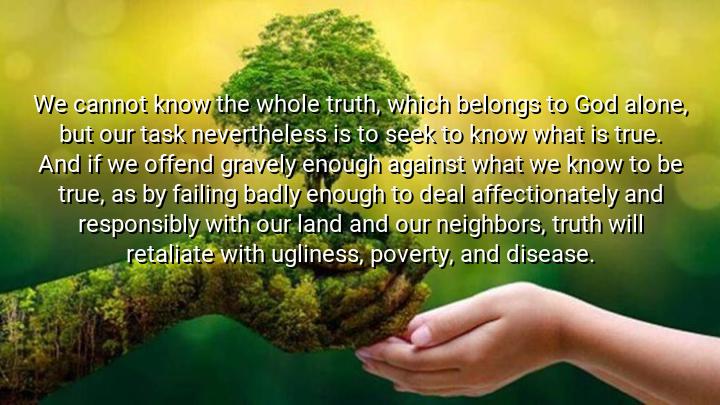




The quote, "We cannot know the whole truth, which belongs to God alone, but our task nevertheless is to seek to know what is true. And if we offend gravely enough against what we know to be true, as by failing badly enough to deal affectionately and responsibly with our land and our neighbors, truth will retaliate with ugliness, poverty, and disease," is from Wendell Berry, a renowned American poet, farmer, and environmental activist. In this statement, Berry highlights the importance of seeking truth, acknowledging that while humans cannot fully comprehend the entirety of truth, it is our responsibility to understand and live in accordance with what we do know.
Berry suggests that our understanding of truth is limited and that it is ultimately divine in nature, belonging to God alone. However, he argues that it is still essential for us to pursue what is true, especially when it comes to our relationship with the land and our neighbors. He emphasizes that responsibility and affection toward both nature and fellow human beings are key to aligning with the truth we can understand.
The quote also warns of the consequences when we fail to live in harmony with what is true. Offending against the truth, particularly by neglecting our duties toward the environment and each other, will lead to negative repercussions. Berry identifies ugliness, poverty, and disease as the inevitable retaliatory forces of truth when we fall short in fulfilling our responsibilities.
Ultimately, Berry’s message underscores the deep connection between truth and the health of the world around us. Our actions toward the land and our neighbors directly impact the quality of our lives and the world we live in. It serves as a call for greater awareness, care, and responsibility in our interactions with both the environment and one another, reminding us that truth is not just an abstract concept, but something that shapes our reality.

TT27 - 9d phan nguyen tan Tu
Emotionally, this quote carries a warning but also hope—that by seeking truth and acting lovingly, we can avoid the harsh retaliation Berry describes. How can individuals cultivate this affectionate responsibility in daily life? Can embracing this mindset lead to transformative change on both personal and societal levels?
TDNguyen Thanh Dat
Reading this, I’m reminded of how interconnected we are with our environment and each other. How can this understanding shape the way we address issues like climate change and community health? Is Berry suggesting that ignoring our responsibilities is not just negligent but actively harmful to all of us?
VHVu Hoy
I find Berry’s idea of truth as something that enforces consequences intriguing. Does this mean truth has an almost moral agency? How might this perspective influence how we view failures in governance, environmental care, or social ethics? What role does acknowledgment and respect for truth play in healing these failures?
NQNhu Quynh
This quote raises a compelling ethical question: what happens when we ignore the truths we do know, especially about our relationship with the land and community? How can societies foster a collective sense of responsibility to prevent the ‘ugliness, poverty, and disease’ Berry warns of? Could this be a call for more compassionate policies and personal accountability?
TV39 Le Nguyen Tuong Vy
Wendell Berry’s quote beautifully captures the humility required in seeking truth, acknowledging that the whole truth is beyond human grasp. How can we balance this humility with the responsibility to act on what we do know? The idea that truth ‘retaliates’ with real consequences is powerful—how does this concept apply to environmental stewardship and social justice today?