

The care of the Earth is our most ancient and most worthy, and after all our most pleasing responsibility. To cherish what remains of it and to foster its renewal is our only hope.
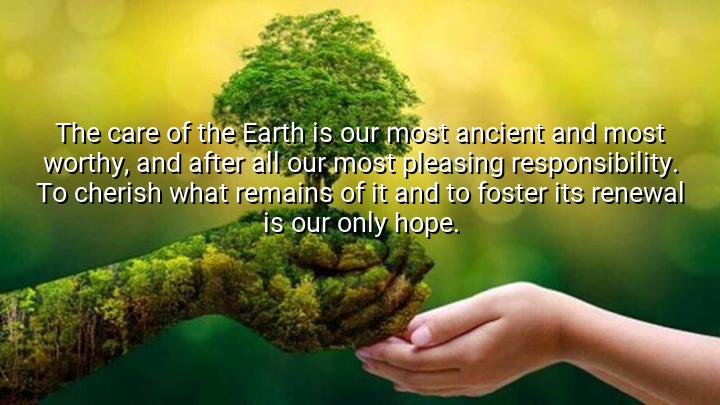




The quote "The care of the Earth is our most ancient and most worthy, and after all our most pleasing responsibility. To cherish what remains of it and to foster its renewal is our only hope" comes from Wendell Berry, an American farmer, poet, and environmental activist. Known for his deep reflections on the relationship between humans and the natural world, Berry underscores the essential and enduring importance of caring for the Earth. He emphasizes that caring for the planet is not a new concern but one that has been central to humanity since the beginning of time.
Berry’s statement frames the care of the Earth as both an ancient responsibility and a noble one. It is the duty of every generation to take responsibility for the world around them, ensuring its well-being and renewal. By calling this responsibility "pleasing," Berry suggests that it should not be seen as a burden but rather as an opportunity to live in harmony with nature, finding fulfillment in protecting and preserving the Earth. Cherishing the planet is not only an obligation but also a path to personal and collective contentment.
The mention of renewal highlights Berry’s belief in the possibility of ecological recovery and the importance of actively participating in the healing of the planet. Despite the damage done to the environment, Berry offers a sense of hope—the idea that through conscious effort, care, and sustainability, the Earth can be renewed. This belief in renewal implies that our actions can still positively influence the future, and that the preservation of nature is not just about maintaining what is left, but actively fostering its regeneration.
Berry’s quote serves as a call to action, urging individuals and societies to prioritize environmental stewardship. He implies that our responsibility to protect the Earth is not only crucial for our survival but also for the well-being of future generations. In a world increasingly affected by environmental challenges, Berry’s message is a reminder that the Earth’s care is both a moral duty and a source of hope for humanity’s future.

AAdministratorAdministrator
Welcome, honored guests. Please leave a comment, we will respond soon