

We all know that Art is not truth. Art is a lie that makes us realize the truth, at least the truth that is given to us to understand.
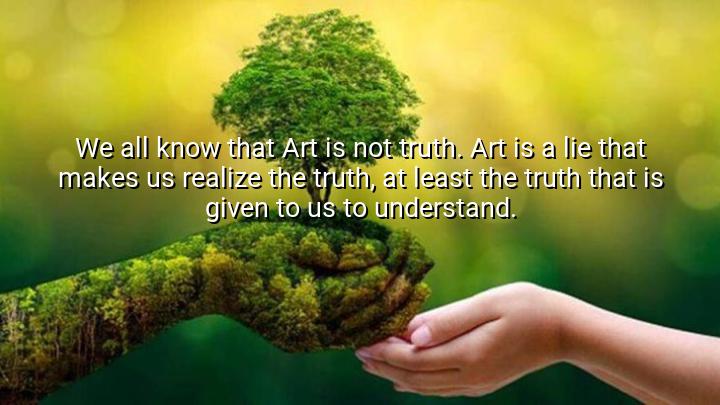




The quote by Pablo Picasso suggests that art is not necessarily a reflection of reality, but rather a constructed representation that helps us perceive deeper truths. Picasso uses the word "lie" to describe the nature of art, implying that it doesn’t depict the world exactly as it is. Instead, it transforms or distorts reality in a way that opens up new perspectives for understanding.
The phrase "makes us realize the truth" points to the power of art to reveal insights about life, emotions, and society that might not be immediately apparent through direct observation. Art, through its imaginative forms and symbolic expressions, allows us to grasp a deeper truth—one that is subjective and shaped by personal or collective experiences.
Picasso's philosophy reflects his own approach to painting, particularly through movements like Cubism, where traditional representations of the world were broken down into abstract forms. The idea that art is a lie but simultaneously reveals a deeper truth aligns with the artist's lifelong exploration of human perception and expression. Through this lens, art becomes a tool for understanding and interpreting the complex nature of existence.

TTThuy Ta thi
This quote makes me think about the difference between emotional truth and factual truth. Art may not reflect real events or literal facts, but it often captures feelings or insights that feel even more real. So, is art more honest than reality in some cases? Can a fabricated story or image express something that cold hard facts never could? It’s a really profound distinction worth exploring.
VVVu vinh
It’s such an intriguing idea that art tells a kind of purposeful untruth. But does that mean artists have a responsibility in the kind of ‘truth’ their work points to? If people draw meaning from these lies, could that be dangerous as well as enlightening? I’d love to hear what others think—can art ever mislead us under the guise of truth, or is that part of its role too?
ATAnh Thu
This quote makes me reflect on the idea of artistic license. Artists often distort reality—through abstraction, symbolism, or exaggeration—but somehow, their work still resonates deeply. Maybe the 'lie' Picasso mentions isn’t about deceit, but about crafting something emotionally real even if it's factually invented. Is that what makes art so powerful? Its ability to evoke authenticity through constructed realities?
HTNgo Thi Huyen Trang
Honestly, this quote has me thinking about the nature of reality itself. If art is a lie, but one that helps us understand the truth, then are we always living in layers of fiction to some degree? Movies, paintings, even news stories—none of them are truly objective. Could Picasso have been predicting the postmodern idea that 'truth' is always mediated through narrative and perspective?
Ddgs
I find myself wondering what Picasso meant by 'the truth that is given to us to understand.' Is he implying that truth is subjective, or perhaps even limited by our personal or cultural filters? If that's the case, then maybe art helps reveal not universal truths, but personalized ones. How do different people come away with different ‘truths’ from the same work of art? Isn’t that a kind of magic in itself?