

I paint objects as I think them, not as I see them.
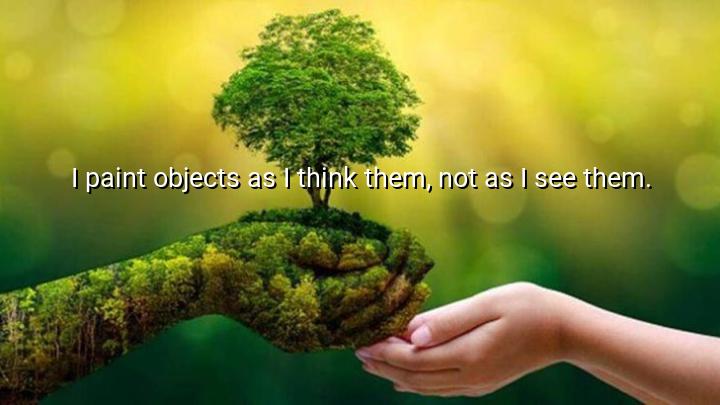




The quote "I paint objects as I think them, not as I see them" by Pablo Picasso reflects his revolutionary approach to art and the concept of representation. Picasso, one of the most influential artists of the 20th century, is known for breaking away from traditional methods of depicting reality. This statement highlights his focus on subjective perception rather than mere visual realism. He suggests that art is not just about what is physically seen, but also about how an artist interprets and internalizes the world around them.
For Picasso, the act of painting was not simply about reproducing the external world, but rather about expressing his inner vision and emotions. He wanted to capture the essence or the idea of an object, rather than its exact likeness. This perspective led to his development of Cubism, a style that deconstructed objects into geometric shapes and represented multiple viewpoints simultaneously. In this way, Picasso transformed the traditional understanding of representation in art.
The quote also suggests a deeper philosophical point about perception and how human beings process the world. It challenges the idea that seeing is the only way to know something. Picasso implies that thoughts and ideas shape our experiences more profoundly than the physical reality we observe. In doing so, he emphasizes the role of imagination and interpretation in the creation of art, suggesting that what we think or feel can be just as important, if not more so, than what we literally see.
The origin of this quote lies in Picasso's personal philosophy and his artistic journey. His work was not bound by conventional rules, and he constantly sought to redefine how art could express the complexities of human thought and emotion. By saying that he paints what he thinks rather than what he sees, Picasso reveals his commitment to innovation and creative freedom, challenging both artists and audiences to view the world through a different lens.

AAdministratorAdministrator
Welcome, honored guests. Please leave a comment, we will respond soon