

Until recently, we regarded love as supernatural. We were willing to study the brain chemistry of fear and depression and anger but not love.
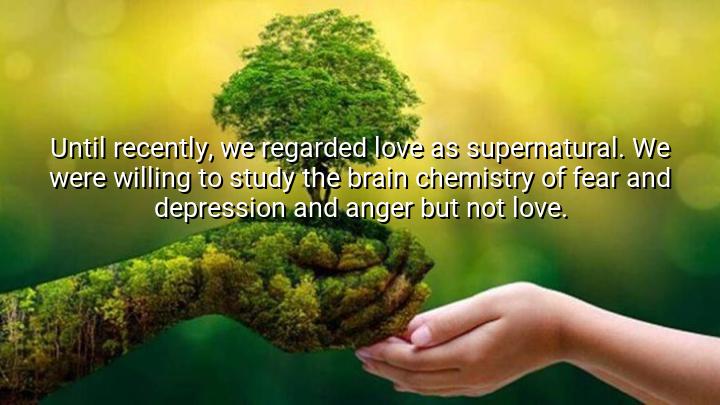




In this quote, Helen Fisher highlights the shift in how we view love compared to other emotions like fear, depression, and anger. She points out that, for a long time, love was considered something supernatural or beyond the realm of scientific understanding. While negative emotions were studied and explored through the lens of brain chemistry and psychology, love remained largely unexplained, often attributed to mystical or abstract forces.
Fisher’s statement suggests that there has been a historical reluctance to treat love as a biological or scientific phenomenon, in contrast to other emotions that have been the focus of extensive research. This reluctance may have stemmed from the belief that love was an emotion too complex or profound to be broken down into physical processes. However, Fisher argues that this perspective is changing, and love is increasingly being understood in terms of brain chemistry and the physiological mechanisms that drive it.
The mention of studying brain chemistry of fear, depression, and anger emphasizes how much more progress has been made in understanding the biological underpinnings of negative emotions compared to love. Fisher's point reflects the growing field of research in neurobiology and psychology, which now includes studies on the neuroscience of love, investigating how specific chemicals like dopamine and oxytocin contribute to the feeling of love and attachment.
Ultimately, Fisher’s quote reflects a shift in perspective about love, acknowledging that it is not just an emotional or spiritual experience, but one that can be scientifically understood. By bringing love into the fold of scientific study, we are beginning to understand it in new ways, shedding light on the biological processes that shape our deepest connections.

TYDang Thi Ye
This statement raises questions about the limits of scientific inquiry into complex human experiences. Can love, with all its nuances, ever be fully understood through brain chemistry alone? How do art, literature, and philosophy contribute to our understanding of love alongside science? It would be enriching to consider these different lenses together.
NTNhi Tran
It’s intriguing that love was excluded from early emotional studies. How does this exclusion shape our collective understanding of love and its role in human behavior? Could the recent scientific focus on love change how people experience or prioritize it in their lives? Exploring this might reveal how science influences emotional culture.
THLe T. Thu Hue
The quote suggests that emotions traditionally seen as negative were easier to analyze scientifically than positive ones like love. Does this reflect societal discomfort with vulnerability or a bias towards pathology? I’d like to discuss how this perception influences which emotions get attention in psychology and neuroscience.
VLVan Lethi
I wonder if the reluctance to study love scientifically was due to cultural taboos or methodological challenges. Now that research is catching up, how might this knowledge impact relationships or therapies? Could understanding love’s biological basis improve emotional health, or might it lead to over-medicalization of human connections?
DMDuc Duong Minh
This quote highlights a shift in how we approach emotions scientifically. Do you think studying the brain chemistry of love helps validate it as a real, measurable experience? Or does it risk reducing something profound to mere chemicals? It would be interesting to explore how this balance between science and romance affects our cultural narratives about love.