

To make us feel small in the right way is a function of art; men can only make us feel small in the wrong way.
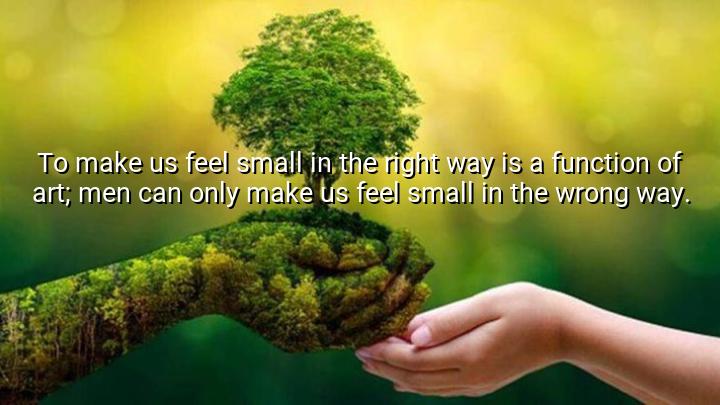




The quote "To make us feel small in the right way is a function of art; men can only make us feel small in the wrong way" by E. M. Forster speaks to the role of art in shaping human emotions and experiences. Forster suggests that art has the power to make us feel small, but in a way that is humbling and profound, offering a sense of perspective about our place in the world. This feeling of smallness is not demeaning but rather serves to elevate our understanding of the greater mysteries of life, nature, or the universe.
In contrast, Forster points out that when men (or people in positions of power) make others feel small, it is usually done with negative intent—such as through manipulation, cruelty, or oppression. The smallness imposed by humans can be degrading and diminish a person’s sense of worth or autonomy. Forster differentiates between the smallness that art can evoke, which inspires reflection and humility, and the smallness that comes from the harmful actions of others, which diminishes and dehumanizes.
Forster’s perspective on art suggests that it should not just entertain or depict beauty but also challenge our perceptions and prompt us to reflect on our existence. By making us feel small in a constructive way, art can help us recognize our limitations and the vastness of the world around us, which can foster a sense of wonder, respect, and connection to something larger than ourselves. This kind of smallness nurtures personal growth, humility, and understanding.
Ultimately, Forster’s quote emphasizes the transformative power of art and its ability to move us in ways that are both humbling and enlightening. In art, smallness becomes a source of insight and growth, while in human interactions, it often becomes a tool for control and degradation. Forster advocates for the kind of smallness that art can instill—one that deepens our appreciation for the complexities of life and the vastness of the human experience.

YDNhu yen Dao
E.M. Forster's words invite a serious question about intent and impact. Art, even when it humbles us, tends to uplift the soul, but when people do it, it’s often laced with superiority or control. Could this be a subtle argument for art as a moral guide—something that teaches us humility without humiliation? I wonder what role empathy plays in this dynamic, both in creating art and interpreting it.
THNguyen Thi Thanh Hang
This quote stirs something in me—I've always believed that great art awakens a feeling of smallness not in weakness, but in wonder. Like it shifts your focus from your personal struggles to something bigger and more eternal. Is this a form of healing? On the flip side, when people make you feel small, it often strips away confidence. Why is one experience so expanding and the other so limiting?
NTMao Nguyen Thi
Forster’s take is interesting—there’s something about being ‘put in your place’ by nature, or art, that feels strangely comforting. But when it comes from another person, it feels like judgment. Why do you think that is? Is it the absence of ego in art that allows it to humble us in a positive way? I'd love to hear what kind of art evokes that gentle sense of insignificance for others.
NTNgoc Thanh
Wow, this is such a nuanced idea. I totally agree that art has a way of shrinking our egos without making us feel worthless. Like looking at the night sky or reading something that expands your worldview. But when people try to make others feel small, it often comes from a place of control. Could art be one of the few things that teaches humility without shame? I’d love to hear examples that have done this for others.
NTnhi trinh
I’m curious—what does it mean to feel ‘small in the right way’? Is it a kind of awe or reverence that reminds us of our place in a vast universe? This quote makes me think about how art creates perspective, not humiliation. Do you think this ties into the concept of the sublime? How can artists responsibly use their work to evoke that balance between humility and inspiration?