

If I had to choose between betraying my country and betraying my friend, I hope I should have the guts to betray my country.
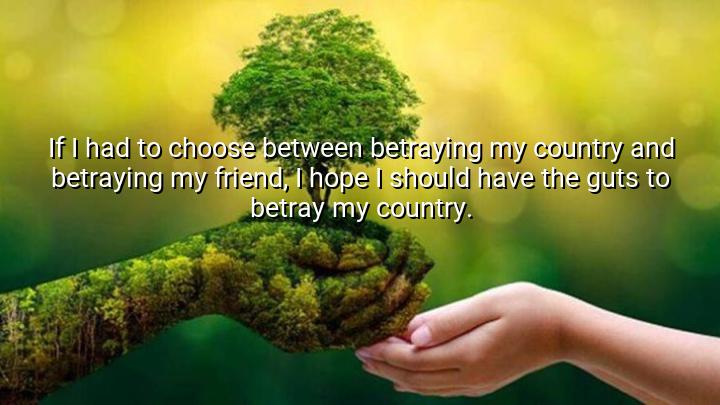




The quote "If I had to choose between betraying my country and betraying my friend, I hope I should have the guts to betray my country" by E. M. Forster speaks to the conflict between loyalty to one’s nation and loyalty to a friend. Forster suggests that personal relationships and friendship hold greater moral value than allegiance to the state. The quote implies that, if forced to choose, betraying a country—a larger, more impersonal entity—is less morally damaging than betraying a friend, whose relationship is based on trust and personal connection.
The origin of this quote can be traced to Forster’s views on individualism and his exploration of human relationships in his works. As a writer, Forster often grappled with themes of personal integrity, morality, and social obligations. He believed in the importance of individual conscience over external pressures, such as those imposed by political or societal norms. This quote is a reflection of his broader belief that personal connections are more valuable than the abstract loyalty to a nation.
Forster’s choice of the word “guts” in this quote further emphasizes the courage required to make such a decision. It suggests that standing by a friend, even at the risk of betraying the country, requires moral clarity and strength. This decision, while difficult, is portrayed as one of deep conviction and personal responsibility.
In essence, this quote challenges the notion of blind loyalty to authority and promotes the idea that human relationships, particularly friendship, are central to moral integrity. Forster is making a statement about the importance of personal ethics and the courage it takes to act according to one’s principles, even when it conflicts with societal expectations or the demands of the state.

AAdministratorAdministrator
Welcome, honored guests. Please leave a comment, we will respond soon