

To know how to grow old is the master work of wisdom, and one of the most difficult chapters in the great art of living.
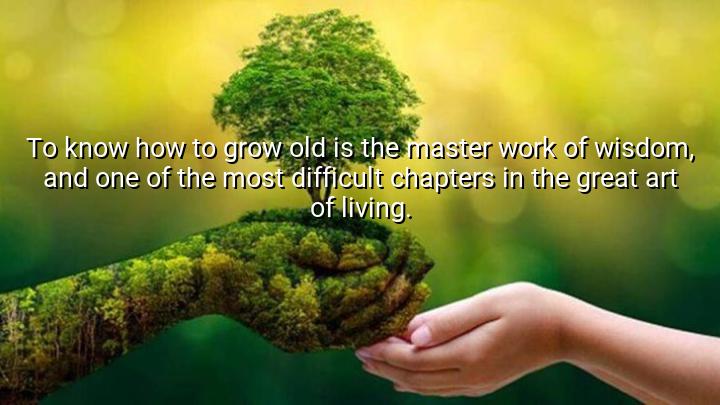




The quote "To know how to grow old is the master work of wisdom, and one of the most difficult chapters in the great art of living" by Herman Melville reflects on the challenge of aging and the wisdom required to navigate it. Melville, an American novelist best known for his work Moby-Dick, suggests that growing old is not just about the passage of time but requires a deep understanding of life and a thoughtful approach to aging. To truly master the art of living, one must understand how to grow older with grace, wisdom, and acceptance.
Melville acknowledges that growing old presents many challenges, both physical and emotional, and it requires great wisdom to embrace this phase of life. As people age, they must come to terms with their changing bodies, evolving roles in society, and the loss of certain abilities or opportunities. This process of acceptance and adaptation, Melville argues, is not easy—it is one of the most difficult aspects of life. Aging, therefore, becomes an important part of the art of living, where mastering the experience of growing old can be seen as an achievement in itself.
The idea that knowing how to grow old is a "master work of wisdom" highlights the value of perspective and self-awareness as people age. Rather than resisting aging or trying to cling to the past, true wisdom lies in understanding and accepting the natural progression of life. By doing so, one can continue to live meaningfully and with dignity, despite the challenges that come with growing older.
Ultimately, Melville’s quote serves as a reminder that aging is a crucial part of the human experience that requires both acceptance and understanding. It encourages people to view growing old not as something to fear or resist, but as an opportunity for continued growth and wisdom, making it an essential chapter in the broader journey of life.

GDGold D.dragon
What strikes me about this quote is its deep reverence for the aging process. It makes me wonder if we’re doing enough as a society to support people through this transition. Are retirement systems, healthcare, and social structures aligned with the idea that aging is a 'chapter' we must actively learn to navigate? Or do we treat it like something passive? I’d love to hear policy makers weigh in on this perspective.
TYNguyen Thi Yen
This made me reflect on how aging isn’t just physical—it’s emotional, psychological, even spiritual. Maybe Melville meant that growing old requires us to let go of control, pride, and even ambition. That’s hard for most of us. Do we resist aging because we don’t want to face mortality, or because we don’t know who we are without our younger selves? Either way, I find this quote profound and unsettling in equal measure.
GNGia Nhi
Honestly, this quote gives me a bit of anxiety. I’m not sure I’ll ever be good at growing old—I'm already struggling with change in my 30s. If growing old well is a ‘master work,’ does that mean most people fail at it? What are the common mistakes, and how can we avoid them? I'd love a roadmap or even a conversation about what that process actually involves.
HGVo Huong Giang
Reading this makes me think of how aging is treated so differently across cultures. In some societies, the elderly are revered as wise leaders. In others, they’re often forgotten or seen as burdens. Is this quote a critique of the way modern life tries to deny aging, or is it more of a personal call to develop inner peace with time? Either way, it makes me want to rethink my own approach to aging.
TQTran Quynh
I find this quote both beautiful and intimidating. It suggests that wisdom isn’t just about what you learn, but how you transition through life’s stages. But what does 'growing old well' even look like? Is it about staying active? Remaining optimistic? Accepting decline with grace? I’d really love to hear what older generations think it means to grow old with wisdom in today’s world.