

Hope is the struggle of the soul, breaking loose from what is perishable, and attesting her eternity.
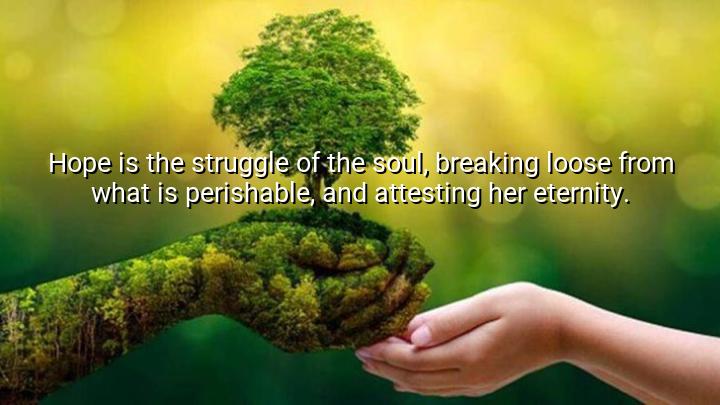




The quote by Herman Melville, an American novelist best known for Moby-Dick, speaks to the spiritual and transformative nature of hope. Melville suggests that hope is not merely a passive feeling but an active struggle of the soul to break free from the constraints of the perishable world. It is through this struggle that the soul affirms its eternity, asserting that despite the transient nature of life, there is something timeless and enduring within us. Hope, in this sense, is a force that connects the finite to the infinite, striving toward a higher, eternal purpose.
Melville’s portrayal of hope as a struggle indicates that it is not always easy or straightforward. Hope requires a battle against the limitations and fleeting nature of material existence, symbolized by the perishable. This aligns with the idea that the soul, in its quest for meaning, must transcend the temporary nature of physical life and seek something greater, something that cannot be destroyed or diminished by time or circumstance.
The origin of this quote is deeply tied to Melville’s exploration of existential and spiritual themes in his work. In Moby-Dick, for instance, characters grapple with questions of fate, existence, and the meaning of life. This quote encapsulates Melville’s belief in the struggle for a deeper understanding of the self and the eternal, as well as the tension between the physical world and the spiritual realm.
In essence, Melville’s quote underscores the idea that hope is more than just a desire for better circumstances; it is an inherent part of the soul’s yearning for something everlasting. By striving to overcome the perishable, hope affirms the soul’s connection to the eternal and speaks to the human desire for transcendence and meaning beyond the physical world.

AAdministratorAdministrator
Welcome, honored guests. Please leave a comment, we will respond soon