

Through a painting we can see the whole world.
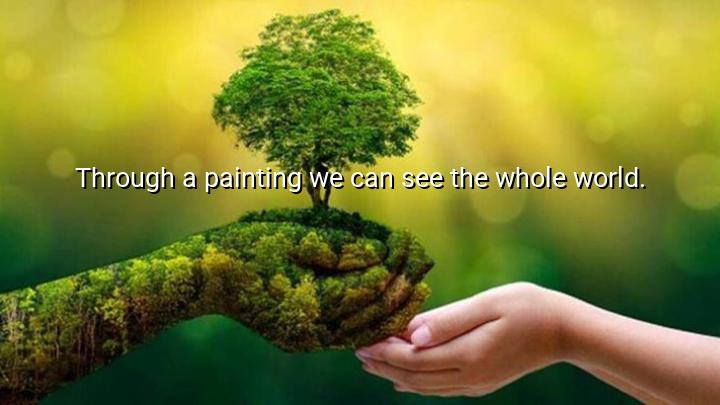




The quote "Through a painting we can see the whole world" by Hans Hofmann suggests that art—specifically painting—has the ability to capture and express the vastness of human experience and the external world. Hofmann, an influential abstract expressionist artist, implies that through the use of color, form, and composition, a painting can encompass not just a specific scene, but the entirety of life’s complexities, emotions, and ideas. Art, in his view, allows the viewer to experience the world from a new and expanded perspective, offering a deep connection to both the artist’s vision and the broader reality.
Hofmann, known for his contributions to modern art, believed that painting was more than just a representation of physical reality; it was a way to interpret and understand the world on a much deeper level. Through the language of art, he saw the potential to communicate universal truths and experiences that transcend the limitations of time, place, and culture. A painting, therefore, becomes a portal through which one can explore the entire human condition and the larger universe of thought and emotion.
The origin of this quote lies in Hofmann’s artistic philosophy, where he emphasized the importance of abstraction and the emotional power of color and form. His abstract work was designed to convey a sense of universal experience, allowing the viewer to engage with the painting not just as a representation of the external world, but as an immersive experience that taps into deeper layers of perception and understanding. For Hofmann, the true power of art lay in its ability to reflect the interconnectedness of all things, offering a vision of the world that is both personal and collective.
For artists, this quote highlights the ability of painting to transcend the limitations of literal representation and offer a more profound, expansive view of life. It encourages creators to see their work not just as a depiction of the world, but as a reflection of the infinite possibilities for meaning and exploration. Hofmann’s words remind us that art has the unique capacity to offer insights into the complexity of the world and our place within it, opening doors to new ways of seeing and experiencing life.

H9Lan Huong 9a1
There's something really comforting in this idea, especially in times when the world feels fractured or overwhelming. If a single painting can somehow contain or reflect everything, maybe that’s why art survives every cultural shift and crisis. But does this mean that every painting inherently has this potential, or only certain ones? Are there specific qualities that make a painting capable of showing 'the whole world' to the viewer?
HHAn Hoa Hong
I wonder if Hofmann meant this philosophically or literally. Can a painting really reflect the whole world, or is it more about evoking a sense of wholeness—a unity of feelings, time, and space? When I look at some works, like those of Van Gogh or Kandinsky, it feels like I’m stepping into another dimension. Maybe that’s what he meant: that a painting opens doors to infinite perspectives, even beyond what we physically see.
KKhuePhung
This quote made me pause. Is it possible that visual art offers a more complete or even truer perspective than written or spoken language? Paintings don’t rely on translation, and yet they seem to say so much. Does this ability to transcend words make painting more powerful in some ways? Or are we overestimating its reach? What does it take for a painting to feel like it reveals something universal?
TTphan thanh thao
I love this idea, but it raises a question: whose world are we seeing through the painting—the artist’s or our own? A painting might show nature, war, love, or chaos, but how much of that is shaped by the viewer’s personal lens? Can two people look at the same work and see completely different 'worlds'? If so, does that make painting a universal language or a deeply subjective mirror?
ATAnna Tran
Is Hofmann suggesting that a single painting has the power to encapsulate all of human experience, emotion, and perspective? That feels both inspiring and overwhelming. I’m curious—does this mean any painting, even abstract or minimalistic ones, can reflect the entirety of the world? Or is it about the viewer’s ability to project meaning onto the canvas? Maybe it's not just about the painting, but also about how we choose to see it.