

A work of art is a world in itself reflecting senses and emotions of the artist's world.
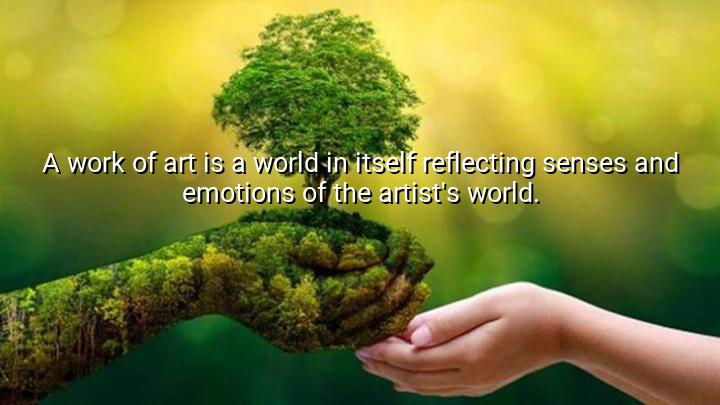




In this quote, Hans Hofmann emphasizes the personal and expressive nature of a work of art. He suggests that each piece of art is a world in itself, a self-contained universe that reflects not just the outward appearance of the world, but the senses and emotions of the artist. Art, according to Hofmann, is a mirror of the artist's inner world—their thoughts, feelings, and experiences—and serves as a personal expression of their unique perspective on life.
Hofmann’s statement highlights the subjectivity of art, implying that it is a direct reflection of the artist’s own reality. Every brushstroke, color choice, or composition carries the essence of the artist's personal engagement with the world, translating their internal experiences into an external form. The work of art becomes a window into the artist's mind, allowing viewers to perceive the world through their specific sensory and emotional filters.
This idea reinforces the connection between the artist and their work, showing that art is not just a technical skill but a medium for emotional and psychological expression. Hofmann implies that through art, the artist is able to communicate abstract emotions and sensory experiences that cannot always be articulated through words. Art becomes a way to express the invisible, giving tangible form to intangible feelings and experiences.
Ultimately, Hofmann’s quote suggests that art is a deeply personal and intimate process. It is a way for the artist to communicate their inner world, making it visible and accessible to others. The work of art serves as both a reflection of the artist's individual perception of the world and a unique invitation for others to engage with that perspective.

TKNguyen Vo Thai Khang
Thinking of a work of art as its own world is beautiful, but also kind of intimidating. Does this mean each piece needs to be explored like a whole universe? And if so, how do we avoid misreading the artist’s 'world'? Can we enjoy and connect with art even if we don’t understand where the artist was coming from emotionally? It’s a thought that really changes how I look at galleries.
NPQuynh nhu Pham
This quote makes me reflect on how art can serve as a kind of emotional archive. But I wonder—do all artists consciously pour their emotions into their work, or can great art still come from technical skill alone? Is emotional expression a requirement for something to be considered truly artistic, or is that just one possible layer of meaning among many?
PVphuong vy
It’s interesting to think of art as a mirror of someone else’s sensory and emotional experience. But what if the viewer doesn’t share any of those same senses or feelings? Can the work still be meaningful, or does it require some level of emotional alignment? I think this quote really opens up the debate on whether art is more about the creator’s intent or the audience’s interpretation.
UNUyen nguuyen
This quote feels poetic, but it raises a question: what happens when an artist's 'world' is chaotic or fragmented? Does the art then become a disjointed world too? And how do we, as viewers, make sense of a world that may not be intended for clarity but rather expression? I find myself drawn to the tension between the personal and the universal in this perspective.
QHQuan Hoang
I really like the idea that every piece of art is like a separate world created by the artist. But does this mean that viewers can never fully understand a work unless they also understand the artist’s inner world? Or can interpretation be just as personal for the audience? I wonder how much of the artist’s emotion truly transfers, or if we end up creating our own meanings instead.