

This avidity alone, of acquiring goods and possessions for ourselves and our nearest friends, is insatiable, perpetual, universal, and directly destructive of society.
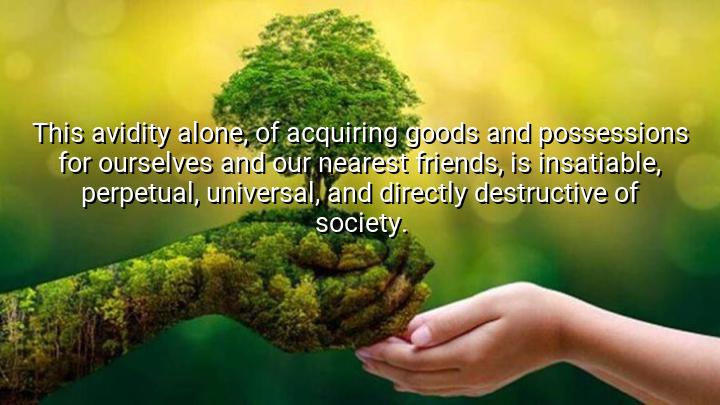




The quote "This avidity alone, of acquiring goods and possessions for ourselves and our nearest friends, is insatiable, perpetual, universal, and directly destructive of society." by David Hume critiques the human desire for material wealth and possessions, pointing out how this relentless pursuit can lead to societal harm. Hume suggests that the insatiable nature of this desire—where individuals continually seek more for themselves and those close to them—becomes perpetual and uncontrollable, undermining the social fabric. The endless cycle of acquisition, Hume argues, erodes the bonds that hold communities together.
Hume’s words reflect his view that self-interest and the constant pursuit of wealth create a distorted society where individual desires outweigh collective well-being. This greed leads to a breakdown of societal values like cooperation, solidarity, and mutual aid. Rather than fostering a sense of community or a shared sense of responsibility, the constant desire for more drives people apart and disrupts the social order.
The quote also emphasizes how human nature—when focused solely on personal gain—can be destructive on a larger scale. Hume is warning that when individuals are driven solely by the desire for personal accumulation, it can harm not only relationships between individuals but also the broader society. In this sense, materialism becomes a social poison, preventing the creation of a harmonious, well-functioning community.
The origin of this quote comes from David Hume, an 18th-century Scottish philosopher, historian, and economist. Hume was a central figure in the Scottish Enlightenment and is known for his work on empiricism, skepticism, and moral philosophy. His critique of human nature and society often focused on the dangers of unchecked self-interest and the social consequences of prioritizing material wealth above moral and communal values. This quote reflects Hume’s broader philosophical views on the importance of balance and self-restraint in maintaining a just and functioning society.

THDo Thi Huyen
This statement invites exploration of alternative values beyond materialism. How might focusing on relationships, creativity, or community counter the insatiable drive for possessions? Can cultures rooted in minimalism or collective well-being offer lessons? What challenges exist in shifting widespread attitudes away from accumulation?
TNTham Nguyen
Hume’s insight feels particularly relevant in the context of wealth inequality. Does unchecked acquisition by some contribute directly to the disenfranchisement of others? How might this influence social unrest or political polarization? Could promoting more equitable distribution of resources improve societal health and reduce conflict?
HNNguyen Hoai Nhan
The quote prompts reflection on how personal desires intersect with collective well-being. How do individual pursuits of possessions affect social trust and cooperation? Are there ways to encourage personal fulfillment without harming societal harmony? What role do policy and social norms play in addressing these tensions?
BPTo Ba Phong
I’m intrigued by Hume’s claim that this desire is universal and perpetual. Does this mean it’s impossible to overcome, or can education and ethics temper these impulses? How might promoting empathy and cooperation reduce the destructive impact on society? Could communal or alternative economic models provide solutions?
MYTran thi my y
This quote raises important questions about human nature and societal values. Is the perpetual pursuit of goods an innate trait, or shaped by cultural and economic systems? How do advertising and capitalism fuel this insatiable avidity? Could shifting focus towards sustainability and shared prosperity counterbalance the negative societal effects Hume describes?