

Generally speaking, the errors in religion are dangerous; those in philosophy only ridiculous.
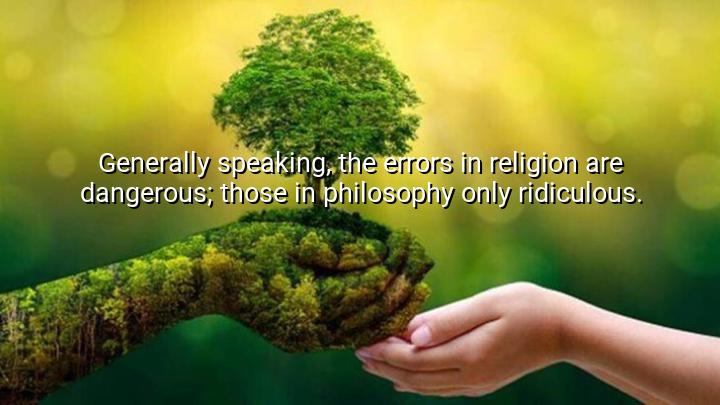




In this quote, David Hume, the Scottish philosopher and historian, contrasts the consequences of errors in religion and philosophy. He suggests that mistakes in religion can have serious, dangerous repercussions, while those in philosophy are mostly harmless and may only lead to ridicule. Hume's view reflects his skepticism about religious dogma and the potential for harmful outcomes when people blindly adhere to religious beliefs without questioning or rational examination. On the other hand, he sees philosophy—though important in shaping thought—as something that remains mostly academic and unlikely to cause real harm when ideas go astray.
The quote reflects Hume’s broader philosophical outlook on religion and human reason. As an advocate for empiricism and skepticism, Hume questioned many established religious and philosophical beliefs of his time. He saw religion as prone to irrationality and dogmatism, which could lead to conflict and violence, especially when individuals or groups held their beliefs without critical thought. In contrast, he viewed philosophical errors as less likely to have dire consequences because they often revolved around abstract ideas that were less immediately impactful on people's day-to-day lives.
Hume’s secular stance is evident here. He was one of the key figures in the Scottish Enlightenment and a strong proponent of rationality and empiricism, which emphasize human experience and observation over religious or metaphysical claims. His skepticism toward religious truths and traditional doctrines, which he believed were often based on faith rather than reason, drove much of his writing, including works like The History of England and An Enquiry Concerning Human Understanding. He felt that philosophical debate, however heated, was more of a mental exercise and less likely to provoke real-world harm compared to errors in religious doctrine.
Ultimately, this quote highlights Hume's belief in the importance of reason and critical thinking, particularly when it comes to religion. While he acknowledged the value of philosophical inquiry, he was much more cautious about the influence of religious faith on society, suggesting that unchecked belief could be far more dangerous than flawed philosophical reasoning.

AAdministratorAdministrator
Welcome, honored guests. Please leave a comment, we will respond soon