

The life of man is of no greater importance to the universe than that of an oyster.
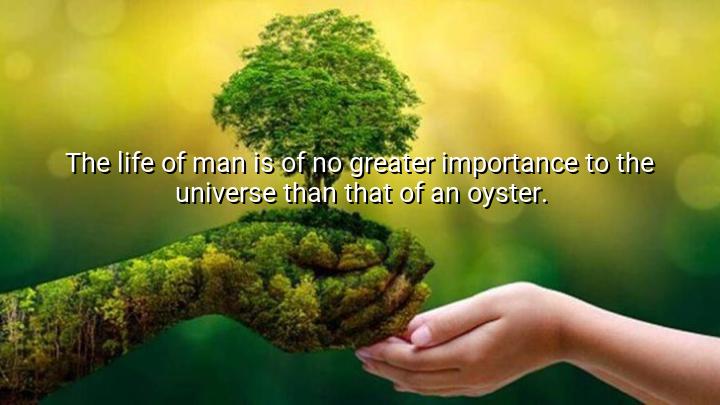




David Hume’s quote speaks to the insignificance of human life in the grand scheme of the universe. He suggests that, in the cosmic context, the existence of a human being is no more significant than that of an oyster—a simple and seemingly insignificant creature. Hume's philosophy here reflects a naturalistic and skeptical outlook on humanity’s place in the vastness of existence, implying that the universe operates according to impersonal laws that do not grant inherent value to individual lives.
This idea is rooted in Hume's broader empiricist philosophy, which stresses the limitations of human reason and knowledge. He famously argued that human beings often overestimate their importance due to their self-centered perspectives, and that the universe, governed by natural laws, operates without regard for the specialness of human life. In his view, the universe does not assign any intrinsic value to our existence; it is merely part of the larger, indifferent flow of nature.
The quote also reflects Hume's skepticism about theological or metaphysical beliefs that elevate humanity’s role in the universe. By comparing human life to that of an oyster, Hume challenges the idea that humans are central to the workings of the world or are particularly special in the eyes of a higher power. This notion reflects a materialistic view of the world, where everything, including human existence, is part of a mechanical system of cause and effect.
Ultimately, Hume’s quote invites readers to consider the humility of human existence and the vastness of the universe. It encourages a perspective where humanity is seen not as the pinnacle of creation, but as a small, transient part of a much larger, indifferent cosmos.

AAdministratorAdministrator
Welcome, honored guests. Please leave a comment, we will respond soon