

There's a lot of bitterness, there's a lot of anger out there. We all have to work hard to heal those wounds.
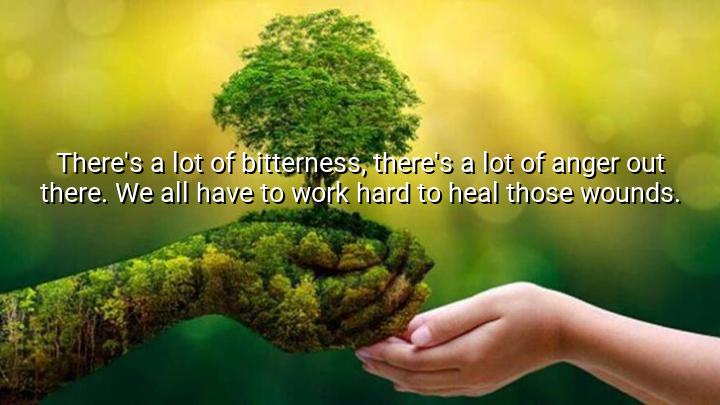




In this quote, Allen Boyd acknowledges the widespread presence of bitterness and anger in society. He recognizes that these emotions are prevalent and deeply felt by many, suggesting that the collective emotional state of the community is one of frustration and unresolved issues. Boyd implies that these negative emotions are not isolated, but rather widespread, affecting individuals and groups across various contexts.
Boyd goes on to emphasize that healing these emotional wounds requires effort from everyone. The use of the word "work" suggests that addressing anger and bitterness is not a passive process but one that requires active participation, empathy, and commitment. Boyd’s call to action implies that healing is a shared responsibility and that it is essential for people to come together to overcome the emotional barriers that divide them.
The quote also hints at the deeper, underlying causes of anger and bitterness, suggesting that these emotions stem from past grievances or societal struggles. Boyd's words speak to the importance of acknowledging these emotions, understanding their root causes, and working through them collectively. Healing requires both personal and communal effort to move beyond resentment and build a more harmonious environment.
Ultimately, Boyd’s quote highlights the challenge of emotional recovery and the necessity of collaboration in the healing process. It suggests that, in order to overcome the negative emotional states of anger and bitterness, there must be a concerted effort to understand, address, and ultimately heal the wounds that have caused them.

KTNguyen K' Toi
This quote feels like a quiet call for compassion, which I really respect. But I’d love to hear how Allen Boyd thinks we can encourage empathy in such a polarized world. How do we create safe spaces for people to talk without fear or defensiveness? And more importantly, how do we teach people to actually listen, not just react? Healing takes effort, but it also takes skill.
TTrabg
I agree with the sentiment here, but I keep wondering—can bitterness and anger actually be part of the healing process? Sometimes those emotions are necessary for people to fully process their pain. Should the goal be to 'heal' quickly, or to allow space for those emotions to be fully felt and understood first? I worry that rushing to fix things can sometimes silence valid outrage.
TBPham Thi Be
I love the hopeful tone of this quote, but I’m skeptical about the idea that 'we all' are equally responsible for healing. Some people have been harmed more than others—shouldn’t the burden fall more on those with power or privilege to initiate repair? Is it fair to expect those who’ve been hurt the most to do the same amount of emotional lifting as everyone else?
PAnguyen thi phuong anh
This makes me think about how bitterness and anger aren’t just emotional states—they’re often responses to very real injustices. If we want to heal, do we first have to confront and fix the causes of that pain? Or is it possible to begin healing even when the systems that created the wounds remain largely intact? I feel like ignoring that context could make efforts seem shallow.
NNNguyet Nhi
I appreciate the empathy in this quote, but part of me questions whether everyone is equally willing to do the emotional labor required for healing. Can true reconciliation happen if some people want to move forward while others hold on to resentment or denial? Healing sounds good in theory, but how do we create the conditions for it when trust has been so thoroughly eroded?