

There is nothing that so much gratifies an ill tongue as when it finds an angry heart.
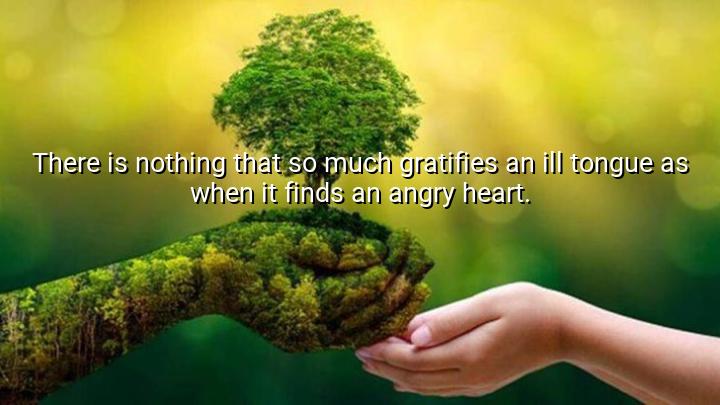




In this quote, Thomas Fuller suggests that an ill tongue—someone who speaks with malice or harshness—finds great satisfaction when it encounters an angry heart. The idea is that people who are inclined to speak negatively or criticize others are often fueled by the emotional responses of others. When someone is already angry, it provides an opportunity for the ill-intentioned to escalate the situation, feeding off the tension and emotions at play.
The term "ill tongue" refers to those who use words to harm or provoke, while "angry heart" describes an individual who is emotionally charged or upset. Fuller’s observation reveals a deeper dynamic in human behavior: anger can often serve as a catalyst for verbal attacks, and those with malicious intent find it easier to thrive in situations where conflict and emotion are already running high.
Fuller’s quote serves as a warning about how anger can be exploited by others. When we allow our emotions, particularly anger, to get the better of us, we risk feeding into the very negativity that we seek to avoid. Instead of calming the situation, an angry heart can encourage more harmful speech and escalation, especially when provoked by others who are ready to exploit it.
The origin of this quote lies in Fuller’s broader philosophical insights, where he often reflected on human behavior and its social consequences. His words remind us of the importance of maintaining emotional control and being mindful of how our reactions can either diffuse or exacerbate conflict.

ANHai Anh Nguyen
I appreciate how this quote exposes the relationship between emotional vulnerability and harmful speech. Could this be why public figures or leaders often face attacks when they show anger or frustration? How does this affect the way we present ourselves in heated situations? It encourages reflection on how emotional composure can be a powerful shield against verbal aggression.
HYNguyen Thi Hai Yen
This makes me think about the role of self-control in avoiding unnecessary conflict. If ill-intentioned speech thrives on anger, then managing our emotions could be a form of self-defense. How do we balance expressing legitimate grievances without letting anger become a tool for others to manipulate us? It also raises the idea that sometimes silence or calmness is the best response to negativity.
TDNguyen Tien Dat
Reading this quote, I’m reminded of how important emotional intelligence is in communication. Do you think people who are angry tend to interpret words more harshly or misunderstand intent? How can we develop awareness to avoid giving ‘ill tongues’ power over us? It seems like a call to guard our hearts and choose responses carefully to maintain peace.
HKHuyen Kim
This statement highlights a toxic dynamic where anger and malicious speech feed off each other. How do we break this cycle in personal relationships or communities? Is it possible that by calming our own hearts, we disarm those who seek to provoke? It also raises questions about the responsibility we have to manage our emotions to prevent fueling conflict.
HHSu Hong Hai
I find this quote insightful because it shows how anger can feed negativity rather than resolve it. Could this mean that those who seek to harm or gossip thrive on others’ emotional turmoil? It makes me wonder how much damage could be avoided if people practiced patience and didn’t respond impulsively. How do we cultivate resilience against the ‘ill tongue’ in everyday life?