

There is no abstract art. You must always start with something. Afterward you can remove all traces of reality.
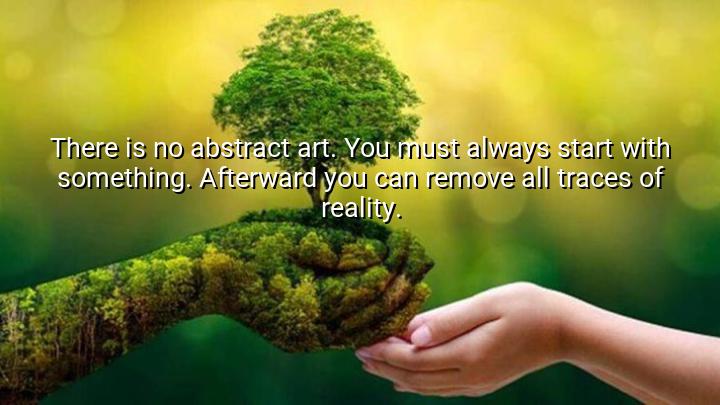




Pablo Picasso’s quote, “There is no abstract art. You must always start with something. Afterward you can remove all traces of reality,” challenges the idea that abstract art is created without any connection to the real world. Picasso insists that even the most abstract or non-representational works begin with a foundation in reality. Whether it’s a human figure, a landscape, or an object, the artist must have a concrete subject to start with before transforming or distorting it through artistic choices.
As the co-founder of Cubism and one of the most influential artists of the 20th century, Picasso constantly redefined the boundaries of representation in art. His works often deconstructed form and space, but they were never entirely disconnected from real-life references. This quote reflects his process—starting from observation and moving toward abstraction by simplifying, exaggerating, or reimagining the subject until only the essence remained.
The phrase “remove all traces of reality” speaks to the artist’s freedom to manipulate or erase the visual cues that make a subject recognizable. Yet even when the final piece appears fully abstract, it still contains a hidden structure or idea grounded in the real world. Picasso believed that meaningful abstraction requires an understanding of form, anatomy, and perspective, even if the artist chooses to break those rules.
Ultimately, Picasso’s quote emphasizes that creativity doesn’t begin in a void. Every artistic journey, no matter how abstract the destination, begins with something tangible. His words highlight the balance between technical foundation and artistic imagination, showing that true abstraction is not a rejection of reality, but a transformation of it.

GLtran gia lac
If we accept Picasso's statement, does it mean that abstraction without a foundation in reality is somehow less authentic or valid? I know many digital or generative artists who create purely from code or randomness—do their works contradict this idea? Or is the 'something' Picasso refers to broad enough to include internal thoughts, algorithms, or even chaos itself?
DNdiep nguyen
This makes me think about the process behind abstraction. Do artists consciously remove reality step by step, or is it more of an instinctive transformation? Picasso’s words suggest a method, almost a blueprint for abstraction. I wonder if this applies across all mediums—like music, dance, or poetry—or if it’s uniquely tied to the visual arts.
TNNguyen Thi Nhu
As someone who doesn’t always 'get' abstract art, this quote actually helps clarify things for me. If every abstract piece has a real-world origin, maybe I’ve just been missing the underlying reference point. But at the same time, it’s kind of frustrating—how are viewers supposed to access the original meaning if all traces of it have been intentionally erased?
TNMai 9A Nguyen Thi Ngoc
This quote challenges how we define 'pure abstraction.' If all art begins with a reference, even a fleeting one, then is the distinction between representational and abstract art more blurred than we usually think? Could it be that abstract art is not a rejection of reality but a reinterpretation of it? I’d love to hear how other artists feel about that idea.
TPThuy Phuong
Is Picasso suggesting that imagination alone isn’t enough—that even abstract creativity must be tethered to some form of observed or remembered reality? That seems a bit limiting, honestly. What about artists who claim to paint or sculpt purely from internal emotion or subconscious expression? Can’t a shape or color exist independently as a visual idea, without being derived from something external?