

The reason why I love people, and writing about them, is because they don't always respond with hate and anger. If they did I wouldn't have a story to tell. Who wants to know about someone who was brutalised and became brutal? I'm interested in the exceptions.
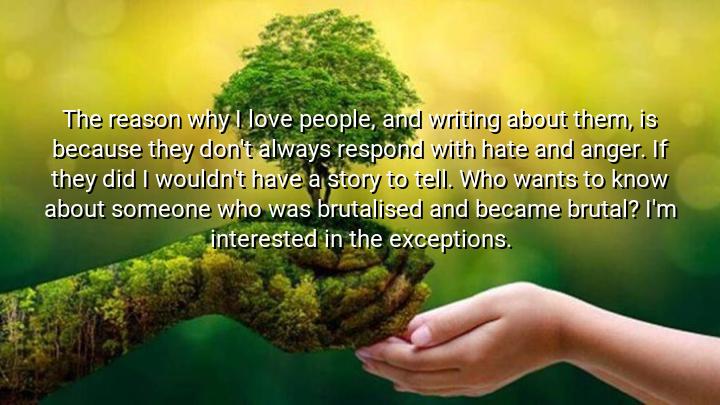




In this quote, Chris Cleave reflects on his fascination with people and the stories he writes about them. He highlights that humanity is often characterized by responses beyond just hate and anger, which is what makes their stories compelling. Cleave emphasizes that if people reacted only with negativity, he would have nothing interesting to write about, as stories of people who become brutal in response to hardship wouldn’t engage the reader. Instead, he seeks out the exceptions—those individuals who defy the cycle of hatred and respond to adversity in more profound and unexpected ways.
Cleave’s interest lies in the complexity of human nature, particularly in how individuals can rise above negative emotions like anger and hatred. The statement suggests that he is drawn to narratives that involve personal growth, resilience, and compassion, especially in the face of trauma or suffering. By focusing on the exceptions, Cleave explores how some people can transcend their struggles without succumbing to bitterness, which makes these stories unique and worth telling.
The origin of this quote likely comes from Cleave’s career as a novelist and journalist, where he has written about human struggles, particularly in the context of war and social issues. His work often delves into the complexities of human relationships, the emotional scars left by trauma, and the strength it takes to respond to life's hardships with grace. Cleave’s emphasis on the exceptions highlights his belief in the power of human hope and the potential for redemption.
Ultimately, Cleave’s quote reflects his belief in the inherent goodness that can arise even in difficult circumstances. While anger and hate are natural human emotions, he is drawn to the stories of those who rise above these feelings to forge a different path. By focusing on these rare and inspiring individuals, Cleave captures the essence of what it means to be truly human: the capacity for growth, empathy, and compassion even in the face of great adversity.

HNHa Huynh Nhu
The quote suggests a deliberate choice to highlight people who respond differently to trauma, which I find hopeful. But I wonder how this focus affects readers’ empathy—do we risk creating a hierarchy of ‘worthy’ stories? How can writers balance the need to tell compelling stories with the responsibility to represent the full spectrum of human reactions to hardship? Would including stories of those who become brutal alongside the exceptions provide a fuller picture?
HTKim Phung Huynh Thi
I find it compelling that the quote acknowledges the typical response of anger and hate but chooses to focus on the opposite. Does this mean that stories centered on healing and forgiveness are more valuable for societal growth? Or could it unintentionally marginalize those who struggle to break free from cycles of violence? How do we ensure that storytelling remains inclusive of all experiences while still celebrating the exceptions?
MHNguyen Manh Hai
This perspective raises important questions about the purpose of storytelling. Why are we drawn to stories where people transcend their pain instead of those where they become hardened by it? Could the desire to focus on exceptions reflect a deep human need for hope? Or might it also reflect a discomfort with confronting the darker sides of human nature? How do you think this shapes our understanding of trauma and recovery?
THDuong Thanh Hung
I appreciate the emphasis on human complexity here. It makes me wonder if the stories of those who break the cycle of brutality are more inspiring because they are rare. But does focusing on exceptions risk creating unrealistic expectations for victims of trauma? How can writers responsibly portray both the harsh realities and the hopeful exceptions without romanticizing suffering or resilience?
PTpto tin
This quote really emphasizes the power of resilience and hope in storytelling. I’m curious—how does focusing on the exceptions who respond with kindness rather than hate shape the narratives we tell about humanity? Could it risk downplaying the reality of trauma and pain by highlighting only the ‘positive’ outcomes? Or does it serve as a crucial reminder that compassion can prevail even in harsh circumstances? What stories have you encountered that challenge this balance?