

The more horrifying this world becomes, the more art becomes abstract.
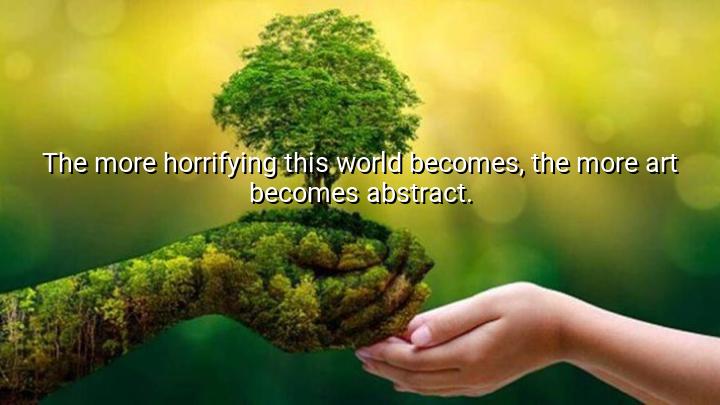




The quote "The more horrifying this world becomes, the more art becomes abstract" by Ellen Key suggests that as the world becomes increasingly difficult or disturbing, art often shifts toward abstract forms as a way to express the complexity of human experience. Key implies that traditional, representational art may no longer be sufficient to capture the growing chaos, confusion, and turmoil of the world. Instead, abstract art, with its departure from literal representation, allows artists to communicate deeper, often unsettling emotions and ideas that cannot be easily conveyed through conventional imagery.
Ellen Key, a Swedish feminist and social reformer, was concerned with the emotional and cultural impact of modern life. Her quote reflects her view that as society becomes more tumultuous, art evolves to reflect the psychological and emotional challenges of the time. Abstract art, with its focus on form, color, and emotion rather than realistic depiction, offers a way to express the inexpressible—a means of coping with the horrors of the world by transforming them into something more abstract and open to interpretation.
The origin of this quote lies in the context of the early 20th century, a period marked by wars, social upheaval, and rapid industrialization. During this time, artists began to experiment with abstract forms as a response to the harsh realities of the world. Movements like Expressionism, Cubism, and Dadaism emerged as artists sought new ways to convey the emotional and intellectual complexities of their time. Key’s words reflect the cultural shift that was taking place, where art became less about representation and more about emotional and intellectual exploration.
For artists, this quote serves as a reminder that art is not only a reflection of the external world but also a means of expressing the inner emotional landscape in response to societal challenges. Key suggests that as the world becomes more difficult to understand and navigate, abstract art becomes a powerful tool for communicating the complexity of human experience. It encourages artists to embrace abstraction as a way of confronting the harshness of reality, offering new ways to engage with the emotions and ideas that shape our perceptions of the world.

TNpham tuan nguyen
I’m intrigued but also a bit unsettled by this statement. It implies a direct relationship between chaos in the world and the evolution of artistic form. But what about viewers? If art becomes increasingly abstract, do ordinary people lose access to it? In a world that’s already disorienting, should art also be disorienting? Or should it try to offer clarity and grounding instead? Maybe abstraction is catharsis for the artist, but confusion for the audience.
TNThu Nguyen
This really makes me think about war-era and post-war art. So many movements—Dadaism, Abstract Expressionism—seemed to emerge in reaction to societal collapse or trauma. It’s like artists couldn’t use traditional forms anymore. Do you think abstraction is a form of protest, or just survival? What happens when horror becomes so normalized that even abstraction feels inadequate? How do artists keep finding new ways to respond when language and images start to fail?
LTLoan Tran
I wonder if this quote is a criticism or an observation. Is Ellen Key suggesting that abstraction is a failure to confront reality? Or is it a necessary evolution of art in dark times? I personally find abstract art more moving when I know the context it came from. But for someone unfamiliar with those horrors, does abstraction risk becoming meaningless, or worse, aesthetically pleasing in a way that glosses over pain?
VTNgan van Trung
I find this idea haunting yet thought-provoking. If art becomes more abstract as the world worsens, does that mean abstraction is a kind of emotional shield? Maybe it’s how artists avoid depicting direct suffering, but still respond to it. Or maybe abstraction offers a kind of freedom—freedom from the literal, from violence. Is this why modern art often feels disjointed or obscure—because it’s born from a fractured world?
KTLe Thi Khanh Trang
This quote really struck me. Do you think abstraction in art is a form of escape from reality, or could it be a deeper form of engagement with trauma and chaos? When things become too painful or complex to represent literally, maybe artists turn to abstraction because it's the only way to express something unspeakable. I'm curious—does abstract art help us process horror, or does it distance us from it even further?