

Christianity is sustained by the knowledge that the object of man's life on earth is his development as an eternal being. Therefore, none of his expressions of life can be an end in itself, but must serve a higher purpose than the earthly life and happiness of the individual - or even than that of the race.
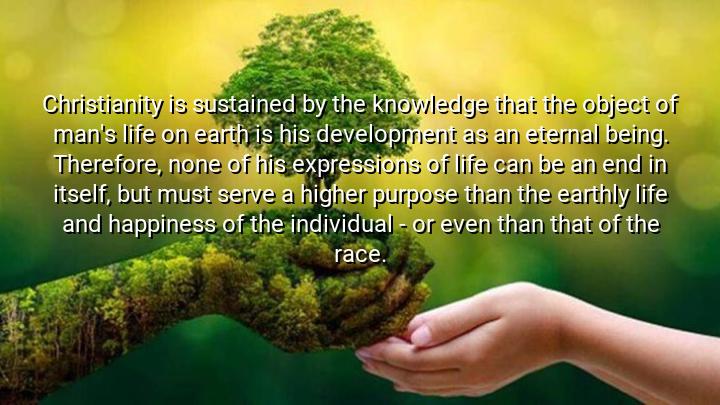




The quote by Ellen Key explores the philosophical and spiritual underpinnings of Christianity. Key emphasizes that the faith is sustained by the understanding that the ultimate objective of human life is the development of the individual as an eternal being. This perspective frames earthly existence as a preparatory stage, where actions and experiences are measured against their contribution to spiritual growth and eternal purpose.
Key argues that none of life’s expressions—such as personal achievement, pleasure, or even societal advancement—should be considered an end in itself. Instead, every action and decision must serve a higher purpose, transcending immediate or individual concerns. This reflects the Christian principle that life should be oriented toward moral, spiritual, and ethical development rather than solely material or temporal goals.
The origin of this statement comes from Key’s work as a Swedish author and social thinker, who often wrote on education, ethics, and the moral development of individuals within society. Her reflection draws on Christian doctrine and philosophical reasoning, emphasizing the moral and spiritual dimensions of human life and the importance of aligning earthly actions with higher, eternal aims.
In essence, the quote underscores that Christianity views life as a means to cultivate eternal growth. Key highlights the need for individuals to orient their earthly actions toward spiritual objectives, suggesting that true fulfillment and purpose lie beyond personal happiness or societal progress, in service of a higher, transcendent calling.

AAdministratorAdministrator
Welcome, honored guests. Please leave a comment, we will respond soon