

The marble not yet carved can hold the form of every thought the greatest artist has.
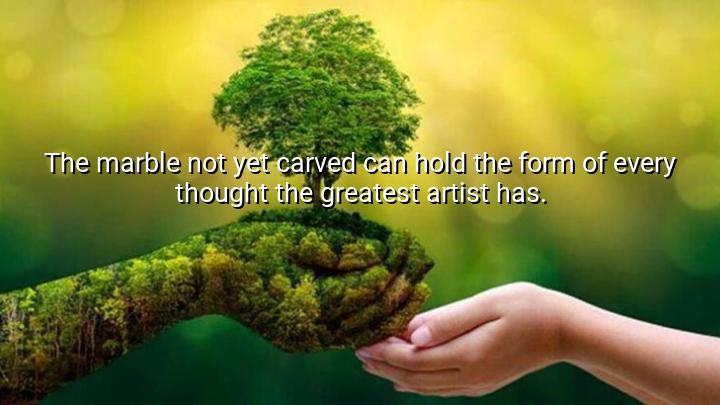




The quote "The marble not yet carved can hold the form of every thought the greatest artist has" by Michelangelo reflects the idea that art is not only about what is physically created, but also about the potential and possibility inherent in a material before it is shaped. Michelangelo suggests that within a block of marble, there is a latent form or idea waiting to be revealed through the artist’s skill and vision. The marble represents both the medium and the untapped potential that the artist sees within it, waiting to be brought to life.
Michelangelo, a master sculptor, is known for his ability to carve intricate, life-like figures out of marble, most famously with works like the David. This quote captures his belief that the artist’s creative vision is not something that is imposed on the material, but rather something that is uncovered and revealed through the sculpting process. For Michelangelo, art is a process of discovery, where the artist must perceive the form that already exists within the raw material.
The origin of this quote comes from Michelangelo's philosophy on creativity and his belief in the power of artistic vision. He often spoke of his work as a process of revealing what was already present in the material rather than creating something entirely new. This approach reflects his deep understanding of the relationship between artist and material, where the artist is seen as a guide who unlocks the potential within the stone, rather than forcing it into a predetermined shape.
For artists, this quote encourages them to approach their craft with a sense of reverence for the potential within their materials. It suggests that the greatest works of art are not necessarily about the imposition of the artist’s will, but about discovering and expressing the ideas and forms that lie within. Michelangelo’s words inspire artists to trust in the process of creation and to see possibility where others might only see raw materials.

NPAnh Thu 7/1 39- Nguyen Pham
This quote made me think about the difference between raw potential and realized creation. We often talk about people having 'untapped potential,' and I think Michelangelo is making a similar point—there’s greatness hidden in silence and stillness. But I wonder: what if the form never gets revealed? Does the potential still matter if no one ever brings it to life? Is unused potential tragic, or simply part of the mystery of existence?
DTThuy Huong Dinh Thi
As a writer, I can relate to this metaphor so much. A blank page feels like uncarved marble—full of ideas, voices, and possibilities. But it’s also intimidating. Sometimes, I fear ruining the potential with a wrong stroke. Does every artist feel that pressure to do justice to the ‘form’ hidden in the raw material? How do you balance respect for the medium with confidence in your vision?
TTNguyen thi thao
There’s something poetic and haunting about this quote. It suggests that art already exists in the raw material—it’s just waiting to be discovered. But does that diminish the role of creativity? Is the artist merely uncovering what’s already there, or actively shaping something new? It raises a philosophical question: is art an act of invention or revelation? I love how this quote invites both interpretations without forcing an answer.
Q9Nguyen Thi Hoang Quyen 9a3
Michelangelo's idea resonates with the notion that creation is as much about vision as it is about craftsmanship. But I’m curious—how does an artist know when to stop carving? If every block of marble holds endless forms, how do you choose just one? It feels like a metaphor for decision-making in general—limiting infinite possibility to one final path. That’s both empowering and terrifying at the same time.
TT.My
This quote stirs something deep in me—it makes me think about potential, not just in marble, but in people, ideas, and moments. If the uncarved marble can contain infinite possibilities, how much of life is waiting for us to shape it with intention? But I wonder—do we always recognize what we’re capable of creating, or do we sometimes need someone else to help reveal the form within us?