

If we have been pleased with life, we should not be displeased with death, since it comes from the hand of the same master.
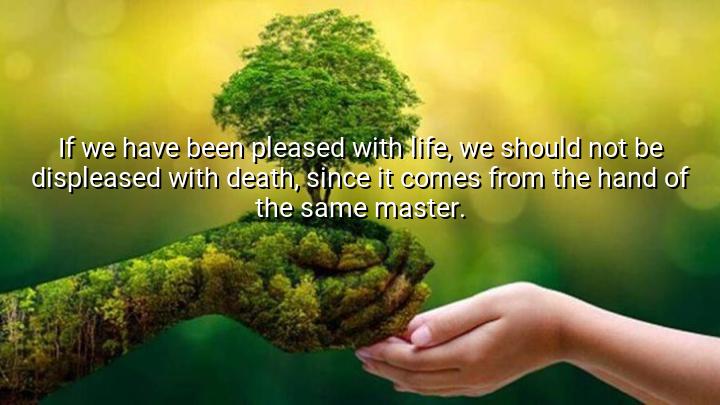




The quote "If we have been pleased with life, we should not be displeased with death, since it comes from the hand of the same master" by Michelangelo reflects the idea that both life and death are part of a larger, divine plan. Michelangelo suggests that if we have found fulfillment and contentment in our life, we should not fear or resist death, as it is an inevitable continuation of the journey that began with life. By referring to death as coming from the "same master" that gave us life, he implies that both are governed by a higher power or divine force, and thus both should be accepted as parts of the same cycle.
The origin of this quote can be found in Michelangelo's philosophical and spiritual beliefs, which were deeply influenced by his faith in Christianity. As an artist, Michelangelo often grappled with the concepts of creation and mortality throughout his work, particularly in his depictions of human suffering and divine beauty. His sculptures, paintings, and architectural designs reflect his belief in the eternal and divine nature of both life and death, as well as the human soul’s relationship with the divine.
In a broader sense, Michelangelo's words encourage a sense of peace and acceptance toward death, viewing it not as something to be feared, but as a natural and harmonious part of the human experience. This perspective aligns with a more stoic or spiritual outlook, where death is seen as the inevitable conclusion to a fulfilling life, and thus, it should not be met with resistance or sorrow. Michelangelo’s quote calls for a balanced and grateful view of life, acknowledging that both joy and sorrow, both birth and death, are intertwined in the grand design of existence.
Ultimately, Michelangelo’s quote serves as a reminder to approach both life and death with equanimity, seeing them as parts of a whole and recognizing that both come from the same divine source. By embracing this perspective, we can live more fully, knowing that death is simply another phase in the eternal cycle of existence, not something to be feared or resented.

AAdministratorAdministrator
Welcome, honored guests. Please leave a comment, we will respond soon