

The history of art is the history of revivals.
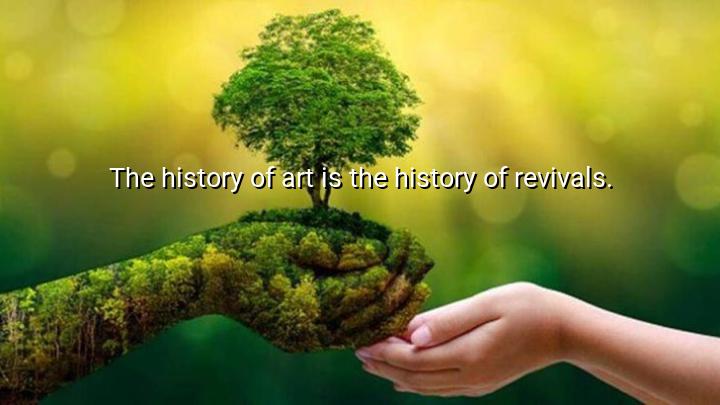




In this quote, Samuel Butler suggests that the history of art is characterized by continuous revivals of past styles, techniques, and movements. He argues that throughout the development of art, there are recurring cycles where artists return to and reintroduce ideas, forms, and themes from earlier periods. These revivals are not mere imitations but reinterpretations that reflect the evolving cultural, social, and technological context. Butler implies that art constantly reinvents itself by revisiting and transforming the past.
The origin of the quote lies in Butler's broader understanding of history and creativity. As a writer and critic, Butler often reflected on the cyclical nature of cultural and intellectual movements. In the context of art, he recognized that artists have a tendency to revive or revisit certain ideas, whether due to admiration, nostalgia, or the need to address contemporary issues through a historical lens. For example, the Renaissance revived classical ideas, Romanticism revisited the emotional depth of earlier periods, and modern movements often draw inspiration from past traditions.
Butler’s statement also speaks to the influence of tradition in art. While each new movement in art may seek to break away from the past, it often builds upon or revisits earlier ideas. This idea of revival can be seen in the way artists borrow from historical styles or techniques to create something new. Each revival is a way for artists to dialogue with history, creating new meanings or interpretations while keeping the core of the past alive.
Ultimately, this quote highlights the idea that art is in a constant state of flux, where periods of innovation are often followed by moments of reflection and revival. Butler's view suggests that the progression of art is not linear but instead a series of conversations with the past, ensuring that history continues to shape the creative expressions of the future. Art, in this sense, is a living, evolving process that is never entirely disconnected from the influences that came before it.

KLphan khanh ly
Reading this quote, I can’t help but think about how trends like retro gaming, vintage photography, and analog music have resurged. Is that simply nostalgia at work, or is there a deeper aesthetic hunger that only past styles can satisfy? Butler’s observation feels timeless, but I wonder—at what point does a revival become something new altogether? Where's the line between homage and innovation?
DHDoan Hien
What fascinates me about this statement is its implication that revival is inherent to the creative process. Does every great movement—like the Renaissance or Neoclassicism—owe its existence to a deep engagement with the past? And if that’s true, how much of contemporary digital or AI art is a revival of older themes in new mediums? Are we seeing a modern echo of earlier revolutions?
HHVu Thi Hong Hanh
This quote brings up a question that bothers me: if art history is just a chain of revivals, what does that say about progress in art? Are we moving forward, or just circling around the same ideas in different packaging? I feel like this challenges the whole idea of modernism and the avant-garde. Can a revival ever truly be revolutionary?
TTTung Thanh
Butler’s take feels very relevant in today's fashion and design worlds, where trends from the past constantly reappear. Does this mean we’re stuck in a loop of nostalgia? Or is there something profound about finding new meaning in old forms? I’d love to hear more about how this concept plays out in non-Western art traditions—are revivals as prominent in cultures with different aesthetic histories?
GAGia Anh
I find this idea oddly comforting. It implies that no artistic idea ever really dies—it just waits to be rediscovered or reinterpreted. Do you think that’s why some styles, like classical realism or surrealism, keep coming back in waves? Maybe artists instinctively look backward to move forward. But then, how do we distinguish genuine revival from mere imitation?