

The drive toward Life is protective, thoughtful, vulnerable, and invested in immaculate love. It is this last that marks the difference between a wise heart muddy with real life experiences in the trenches and a dry heart that functions on rote concepts alone.
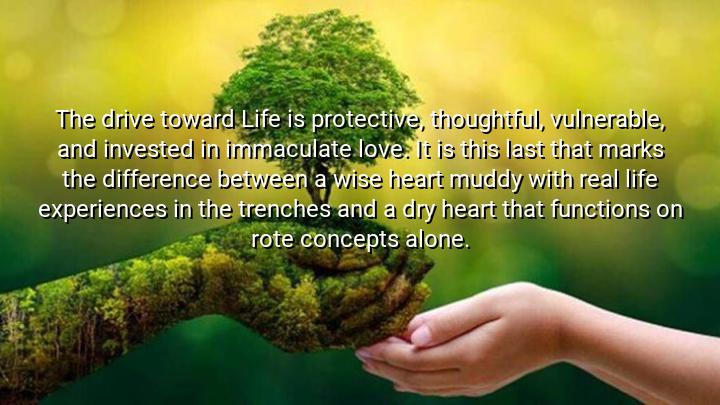




In this quote, Clarissa Pinkola Estes contrasts two types of hearts: one that is wise and shaped by real life experiences and another that is dry and detached, operating merely on rote concepts. She suggests that the drive toward life is not merely about surviving or functioning mechanically; it is deeply protective, thoughtful, and vulnerable. This drive is invested in immaculate love, which represents an ideal and deeply caring form of engagement with life. This type of love is protective and thoughtful, guiding one through the challenges of life with empathy and wisdom.
Estes emphasizes that a wise heart, shaped by real experiences, is different from one that merely follows established routines or concepts. The wisdom that comes from enduring life’s difficulties, especially those “in the trenches,” creates a heart that is more attuned to the complexities of life. This type of heart holds vulnerability as a strength, recognizing that true emotional engagement requires openness and a willingness to be affected by the world. In contrast, a dry heart, focused on abstract theories or conceptual knowledge, lacks this depth and emotional engagement, making it less capable of love and empathy.
The quote also points out that immaculate love—the pure, protective, and thoughtful love that comes from living fully—marks the difference between a truly wise heart and one that merely functions in a detached or mechanical way. Love, in this context, is not just a theoretical concept, but something lived and experienced, bringing a richness and depth to one’s emotional life. It is through this love that one gains wisdom, rather than relying on simplistic or surface-level understandings of life.
Ultimately, Estes' quote highlights the importance of experience and emotional engagement in developing true wisdom. It suggests that only through living authentically—embracing both the vulnerability and challenges of life—can we develop the type of wisdom that leads to a heart full of love and understanding. This wisdom is not derived from abstract knowledge, but from the ability to connect deeply with the world and others.

TLTV Lloyd
This quote feels like a celebration of emotional depth over sterile logic. It resonates with me, especially in a world where being vulnerable is often seen as weakness. But I wonder—how do we honor that 'muddy wisdom' without losing our balance? Experience teaches us so much, but it can also wear us down. Where’s the line between growing wise and growing weary? That’s something I’d love to explore more.
Nnoname
I find this incredibly moving, but also a little intimidating. The idea that love must be 'immaculate' makes me question whether I’ve ever truly achieved it. Is this standard of love attainable, or is it more of an ideal to strive toward? And what happens when our own trauma muddies the waters? Can a heart still be considered wise if it struggles to fully embody that purity of intention?
TPThao Phuong
This quote speaks volumes about the difference between living and simply existing. It makes me think about people who live by rules and theories but rarely touch the emotional core of life. How do we shift from that 'rote' functioning to something more alive and heartfelt? Is it just about experience, or is there a conscious decision to feel, risk, and love with vulnerability every day?
VLVinh Le
Estes' words feel like a quiet call to stop intellectualizing and start feeling more deeply. But I can’t help wondering: how do we cultivate a 'wise heart' without being consumed by the pain that often comes with experience? Life in the trenches sounds admirable, but also exhausting. Is there a way to preserve emotional clarity and still remain tender, without hardening or shutting down?
NDTRAN NGOC DIEN
This quote really touches me—it speaks to the richness that comes from lived experience. But I wonder, what does 'immaculate love' mean in a world that is often messy, cruel, and complicated? Is it about unconditional compassion, or something even deeper? I’m curious how one maintains this pure form of love without becoming jaded by life’s many disappointments. Can wisdom and innocence truly coexist?