

The construction of Europe is an art. It is the art of the possible.
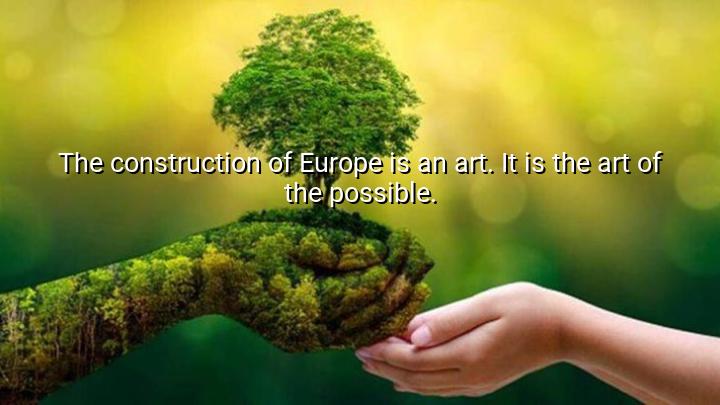




Jacques Chirac’s quote, "The construction of Europe is an art. It is the art of the possible," suggests that the process of building a unified and cohesive Europe is a complex and delicate task, much like creating a work of art. Chirac highlights that European integration and cooperation require careful diplomacy, strategy, and compromise, as these efforts often involve navigating competing interests and diverse national identities. The art in this context refers to the skill and vision needed to manage the complexities of the continent's political, social, and economic landscape.
The phrase "art of the possible" implies that while grand ideals and aspirations for European unity exist, the reality of achieving them involves making pragmatic choices based on what is realistically achievable. It suggests that progress in European construction doesn’t come from a utopian vision but from finding common ground among nations with different cultures, histories, and priorities. The focus is on what can be accomplished, rather than what might be ideal.
Chirac’s words reflect his own political approach during his presidency of France, where he sought to balance national interests with broader European goals. The quote acknowledges that, while the idea of a united Europe is a noble one, the path to it is incremental and requires flexible negotiations and adjustments. It is an ongoing process of compromise, and leaders must work within the limits of what can be practically achieved, rather than pursuing perfection.
Ultimately, this quote speaks to the dynamic and evolving nature of European integration. Europe’s construction is not about a fixed endpoint but rather a continuous process of adjustment and adaptation, where the art of the possible guides decision-making. Chirac’s words emphasize the importance of realism and pragmatism in political leadership, especially when building something as complex as the European Union.

TThien
It’s interesting how this quote frames European integration not as a science or a strategy, but as art—suggesting nuance, subtlety, and interpretation. But is that romanticizing what is essentially a political and economic process? Do citizens of the EU really see themselves as part of an artistic project, or do they just want results: stability, jobs, and rights? I wonder if calling it ‘art’ risks alienating people who just want effective governance.
L7Thao Ly 7/2
This quote really resonates with the idea that politics is more about gradual progress than idealistic leaps. But I’m curious—how does this philosophy hold up in times of crisis, like Brexit or economic collapses? Is 'the art of the possible' still useful when trust between member states is strained? Maybe this approach works in peacetime, but does it fall short when radical, unified action is needed?
HTHong Tham
I find this quote really thoughtful—it highlights how the EU has always been more about patient negotiation than sudden transformation. But it also makes me wonder: in trying to unite so many nations under one system, are we creating something too dependent on compromise? Does the focus on what's ‘possible’ make it harder to address deeper systemic issues that require stronger, possibly more divisive action?
KDThai Khac Dat
This quote seems optimistic, but is it a bit too pragmatic? Framing Europe as the ‘art of the possible’ sounds like a way to justify settling for what can be done, rather than pushing for what *should* be done. Especially with rising nationalism, economic inequality, and climate crises, is it enough to work within the limits of possibility? Shouldn’t visionary leadership be about expanding those limits instead of accepting them?
Ppham
I'm fascinated by the idea that building Europe is a kind of art form. Does this imply that diplomacy, negotiation, and compromise are as creative as painting or music? If so, who are the artists—politicians, citizens, or institutions? And how do you evaluate success in a ‘work of art’ as vast and dynamic as Europe? I’d love to hear how people interpret the role of creativity in political and economic union.