

One can go to war alone, but you can't build peace alone.
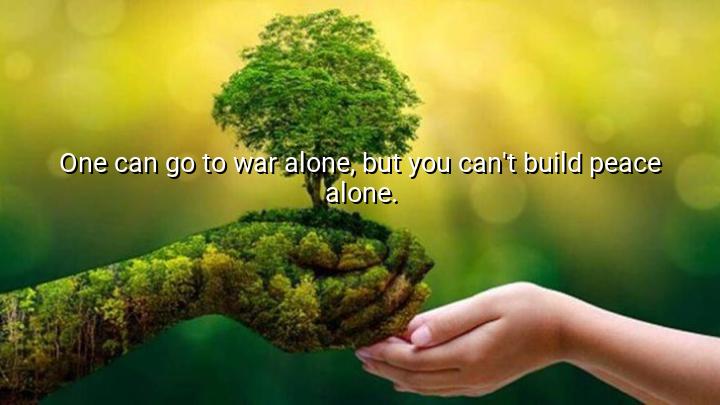




In this quote, Jacques Chirac draws a distinction between the processes of war and peace, highlighting that while war can be initiated and fought by an individual or a group, building peace is inherently a collective effort. War can often be driven by a single actor or a limited group of people, but creating a lasting peace requires the cooperation and involvement of many parties. Chirac suggests that peace is a more complex and fragile process that demands collaboration, dialogue, and mutual understanding.
Chirac’s statement reflects the broader idea that peacebuilding goes beyond the cessation of conflict; it involves rebuilding relationships, institutions, and societies in a way that ensures lasting stability and cooperation. While the act of going to war may come from a singular desire or a focused conflict, the task of building peace requires addressing the root causes of conflict, reconciling differences, and establishing trust, all of which demand the participation of multiple stakeholders, including governments, communities, and international organizations.
The quote also speaks to the concept of global cooperation. Unlike war, which often arises from division and opposition, peace requires people to work together, overcoming their differences for the common good. Whether in the context of international diplomacy, civil conflict resolution, or community-building, peace is something that cannot be imposed unilaterally but must be the result of joint efforts aimed at mutual understanding and sustainable reconciliation.
Ultimately, Chirac’s quote emphasizes the idea that peace is a communal and collaborative achievement, in contrast to the isolated or divisive nature of war. It is a call for collective action and cooperation in resolving conflicts and creating stable, harmonious societies. The quote underscores the complexity of peace, urging a focus on unity rather than division in the pursuit of a better, more peaceful world.

NPNguyen Phong
There’s something profoundly sobering about this quote. It acknowledges the solitary nature of aggression but also the communal spirit required for healing and restoration. Do you think this is why peace processes often stall—because we underestimate how much buy-in is needed from everyone involved? It makes me wonder if peacekeeping efforts fail not due to lack of desire, but lack of genuine collaboration and trust-building mechanisms. How can we fix that?
PVDat Pham Van
This statement makes me reflect on how much easier it is to tear down than to build up. War can be sparked by a single decision, but peace needs dialogue, patience, and shared vision. I wonder how this applies outside of politics—like in relationships or communities. Can peace in families or teams be sustained if even one person refuses to participate in healing? It really highlights our interconnectedness and responsibility to each other.
MTNguyen Minh Thien
I love the realism in this quote. It’s easy to idolize peace, but it reminds us that peace isn't passive—it requires participation, collaboration, and sometimes sacrifice from all sides. But it also raises a concern: what happens when only one party is truly committed to peace? Can peace still be built if others remain stuck in cycles of revenge or resistance? This makes me think about modern conflicts and failed negotiations.
KLpham khanh ly
I find this incredibly thought-provoking. It seems to imply that peace is inherently a shared value, something no individual can impose or control alone. But that makes me ask—how do we even start the process of peace when the people involved don’t trust each other? Can a single leader inspire peace if the broader community isn’t ready to engage? Is diplomacy always a two-way street, or can one side lead the way?
D109 Nguyen Cao Anh Dung 11A2
This quote really resonates with me—it's such a powerful contrast between destruction and creation. War can be driven by one person's ambition or anger, but peace seems to require collective effort, compromise, and understanding. I wonder, though, why peace often feels so much harder to achieve than conflict. Is it because trust and cooperation are more fragile than fear or dominance? What does this say about human nature and our priorities?