

The artist is a receptacle for emotions that come from all over the place: from the sky, from the earth, from a scrap of paper, from a passing shape, from a spider's web.
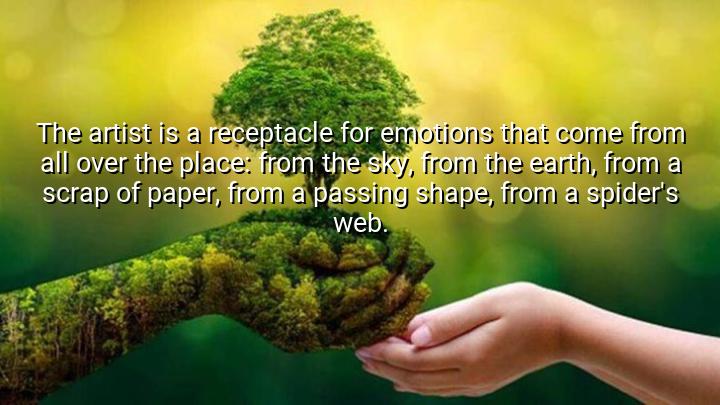




The quote "The artist is a receptacle for emotions that come from all over the place: from the sky, from the earth, from a scrap of paper, from a passing shape, from a spider's web" by Pablo Picasso emphasizes the idea that artists are vessels that absorb and process a wide range of emotions and experiences from the world around them. Picasso suggests that inspiration for art does not come from a single source but from the multitude of sensory and emotional stimuli that surround the artist in their environment. Whether it's nature, fleeting moments, or seemingly insignificant objects, the artist captures and translates these influences into their work.
Picasso, a master of modern art and a pioneer of Cubism, recognized that art was not just about replicating what is seen but about interpreting and expressing the world in its many forms. The receptacle metaphor suggests that the artist is open to receiving and processing various emotions and sensations, which are then transformed into creative output. This view positions the artist as someone who not only observes the world but also internalizes and synthesizes diverse influences, turning them into something uniquely personal and expressive.
The origin of this quote lies in Picasso’s broader artistic philosophy, which often focused on the importance of embracing creativity and the role of the artist in interpreting the world. Picasso was deeply influenced by the things around him, and his works often incorporated elements from his everyday environment, whether through abstract shapes, natural forms, or symbolic objects. He viewed art as an ever-evolving process of receiving and translating emotional and sensory input into something meaningful.
For artists, this quote highlights the importance of being open to the inspiration that comes from all parts of life. It encourages creators to be receptive to the world around them and to see the potential for creativity in even the smallest or most unexpected things. Picasso’s words remind artists that emotions can be drawn from anywhere and that the true power of art lies in the ability to distill those diverse experiences into something universal and expressive.

HTDang Thi Huong Tra
This quote almost sounds spiritual to me, like Picasso saw creativity as a force that moves through the artist rather than something the artist owns. It reminds me of the idea that artists channel something bigger than themselves. But then, where’s the boundary between inspiration and self-expression? If all these outside elements flow into an artist, how do they still claim the final piece as their own creation?
BTDao Bao Tram
Does this mean that anyone could be an artist if they allowed themselves to be this receptive? Or is Picasso pointing to a rare kind of perceptiveness that only some people develop? I’m curious whether this receptivity is innate or something that can be cultivated through practice. Can you learn to see the world through this emotional lens, or is it something artists are simply born with?
TVPham Nguyen Thuy Vy
This resonates with me in such an unexpected way. It makes art feel like a dialogue with the universe rather than just self-expression. If a shape or a scrap of paper can move an artist, does that mean everything holds potential meaning? It’s kind of beautiful to think of the world as full of silent messages waiting to be interpreted through art. But how do you stay open to that without becoming overwhelmed?
PKThuy Phuong Khong
I wonder if this quote also hints at the unconscious nature of creativity. Maybe Picasso is saying that artists don’t always know where their ideas come from—they just feel things deeply and express them. Does that mean technical skill is less important than emotional awareness? Or is it the balance of both that makes great art? It’s interesting to consider the artist as a kind of emotional antenna for the universe.
HLHanh Le
This quote makes me think about the sensitivity required to be an artist. If inspiration truly comes from anywhere—a spider’s web, a piece of trash—then being an artist must involve seeing meaning in things most people overlook. But doesn’t that constant openness get overwhelming? How does one manage being so emotionally receptive without burning out or losing a sense of self in all that external input?