

The artist belongs to his work, not the work to the artist.
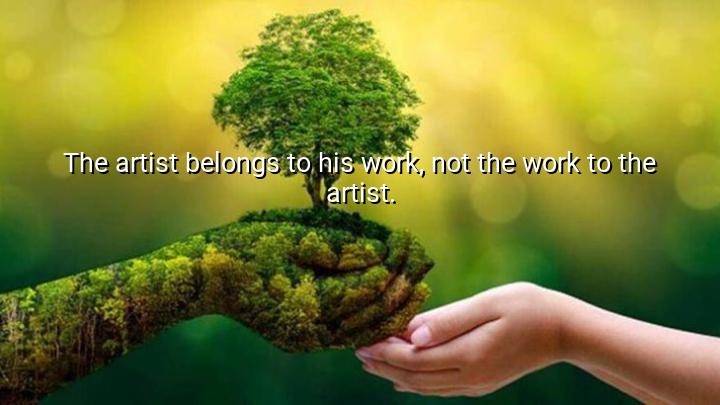




The quote "The artist belongs to his work, not the work to the artist" by Novalis suggests that art is not something the artist owns or controls in a conventional sense, but rather, the artist is bound to the creation itself. Novalis, a German poet and philosopher associated with the Romantic movement, emphasizes the idea that art is a force larger than the individual, and that once a piece of art is created, it takes on a life of its own, independent of the artist. The artist, in this view, is a servant to the work, which transcends the artist's personal identity and intentions.
This perspective challenges the traditional view where art is seen as a mere expression of the artist's personal vision, mastery, or skill. Novalis suggests that the creative process is not simply about the artist exerting control over the work, but about responding to the deeper, often unconscious forces that shape the art. The artist is seen as a vessel or channel through which the work emerges, meaning the artist cannot claim complete ownership or control over its meaning or impact once it is made.
The quote also reflects Novalis's belief in the transcendence and universality of art. When an artist creates something of true significance, it no longer belongs to the individual but becomes a part of the wider cultural or spiritual landscape. The work continues to live, evolve, and resonate with others, independent of its creator. In this sense, art becomes a shared experience, capable of speaking to many people across time and space.
Ultimately, Novalis's statement elevates art above the artist, suggesting that the true power of a work lies in its ability to transcend individual identity. The artist's role is not one of ownership but of participation in something greater, allowing the work to take on its own life and meaning, separate from the person who created it.

THDuk Ta Huy
Such a compelling quote. It implies a sort of spiritual devotion—almost like a priest to a calling. But how does this hold up in today’s commercialized art world where artists often create with the market in mind? Can art truly maintain this sacred separation from its creator in an era where artists are brands and their names often matter more than the work itself?
KCHa Kieu Chinh
Is Novalis advocating for artistic surrender? This quote challenges the notion of ego in art-making. If the artist 'belongs' to the work, are they simply tools in service of a higher creative process? I wonder how this applies to more personal or autobiographical art—does the work still transcend the individual, or does it remain tied to them emotionally and contextually?
DHDuong Hanh
Reading this quote, I feel both inspired and uneasy. On one hand, it honors the autonomy of the artwork, but on the other, it suggests the artist is somehow secondary. Is this perspective empowering because it speaks to devotion, or limiting because it minimizes authorship? Could this mindset prevent artists from asserting their identity or voice through their work in an age obsessed with personal branding?
HLTran Ha Linh
I find this idea strangely humbling. If the artist belongs to the work, then perhaps their role is more like a vessel or medium through which the art is born. It makes me ask—how much control should an artist really assert over the reception or legacy of their work? Is there value in detaching from your creation once it’s finished, like letting a child go out into the world?
CLCuc Le
This quote makes me wonder about the boundaries between the artist and their creation. Is Novalis suggesting that once art is made, it transcends its creator? That the artist is in service to the work, rather than the other way around? It flips the common idea of ownership. Can art ever truly belong to the artist if its meaning shifts with every new viewer and interpretation over time?