

Where children are, there is the golden age.
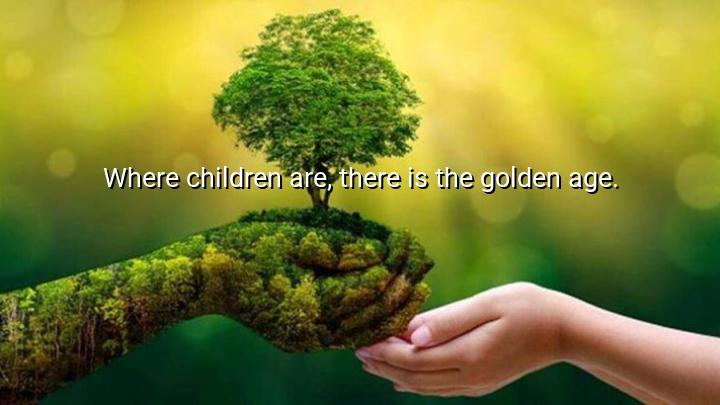




In this quote, Novalis, a German Romantic poet and philosopher, suggests that the presence of children signifies the essence of the golden age. By associating children with this idealized period, Novalis highlights their purity, innocence, and potential for boundless joy and wonder. The "golden age" traditionally refers to a time of peace, prosperity, and happiness, often thought of as an idyllic, carefree era. Novalis implies that childhood, with its untainted outlook and natural curiosity, embodies these qualities and represents a time when life is most fulfilled and unspoiled.
The quote reflects the Romantic philosophy, which emphasized a return to nature, simplicity, and emotional authenticity. In the context of Romanticism, childhood was seen as a period of uncorrupted virtue, a time when humans were most in tune with the natural world and their inner selves. Novalis was deeply influenced by this worldview, and his statement underscores the belief that the simplicity and innocence of children offer a glimpse into a perfected state of being that adults often long for but lose as they age.
The origin of this quote comes from Novalis’ works during the late 18th and early 19th centuries, where he often explored themes of idealism, spirituality, and the human connection to the universe. As a key figure in the German Romantic movement, he was fascinated by the spiritual and transcendent qualities of the world, believing that children, in their natural state, could access a deeper, more meaningful connection to life.
Ultimately, Novalis’ quote serves as a celebration of childhood and its ability to represent an idealized version of life. By associating children with the golden age, he encourages us to recognize and appreciate the purity, joy, and innocence that children bring into the world, reminding us that these qualities are precious and worth preserving.

HNHanh Nguyen
What a simple but deeply philosophical idea. It makes me think about how many cultures associate childhood with purity, beginnings, and even divinity. Is the quote suggesting that true happiness or ideal living is tied to the qualities children represent? If so, are we doing enough to integrate that into our adult lives—through creativity, playfulness, or openness? Or do we leave those things behind far too soon?
SADo Si An
This quote makes me smile. It captures something that’s hard to explain—how a child’s laughter, their wild imagination, or even just their questions can shift the whole atmosphere of a room. But then I wonder: as we age, do we lose that 'golden' quality? Or is it still inside us, buried under layers of practicality? Maybe being with children is a way to rediscover parts of ourselves we’ve forgotten.
BHDoan Bich Hanh
I’m struck by the emotional warmth of this quote. It feels like a reminder that children aren’t just our future—they are a living source of light in the now. But I also feel a little conflicted. How do we balance this ideal with the reality that many children face neglect, trauma, or poverty? If their presence symbolizes something golden, how can we justify a world that doesn’t always protect or value them enough?
NSNguyen Thi Ngoc Suong
There’s a subtle but powerful truth here. Children live in the present in a way that most adults forget how to. Maybe the idea of a 'golden age' isn’t about nostalgia or history, but about presence, wonder, and openness—all qualities kids embody naturally. Could we create a better society by modeling ourselves more after the emotional lives of children rather than always trying to teach them ours?
DTNguyen Duc Thang
I love the idealism in this quote. It reminds me that the innocence and curiosity of children can be a kind of spiritual compass. But I also wonder—do we romanticize childhood too much? Not every child experiences a golden age. For some, childhood is filled with hardship. Maybe the quote is more aspirational than descriptive, pointing to what we should be striving to create wherever children are.