

Some painters transform the sun into a yellow spot, others transform a yellow spot into the sun.
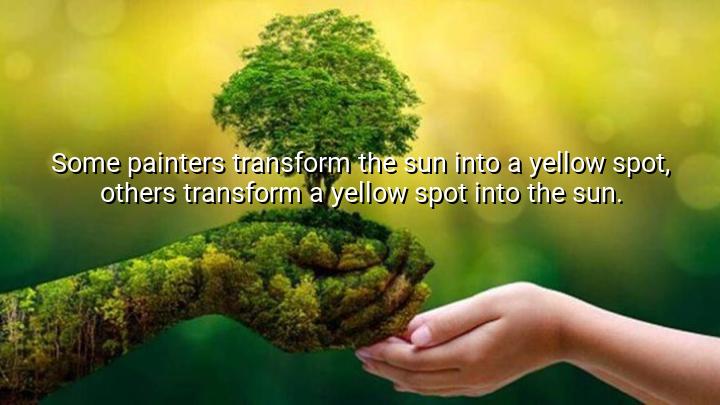




The quote "Some painters transform the sun into a yellow spot, others transform a yellow spot into the sun" by Pablo Picasso highlights the difference between literal representation and imaginative reinterpretation in art. Picasso is drawing a distinction between two approaches to painting: one where the artist faithfully replicates what is seen in reality—such as turning the sun into a yellow spot on the canvas—and another where the artist transforms a simple object, like a yellow spot, into something far greater, imbued with deeper meaning or energy, such as representing the sun in all its warmth, power, and symbolism.
Picasso's statement suggests that art is not just about mimicking the external world but about how the artist reimagines and reinterprets what is seen. In this view, the second type of artist does not simply copy the appearance of things but instead infuses them with new possibilities, conveying their own vision and emotions. By transforming a yellow spot into the sun, the artist creates something transcendent, elevating the mundane into the extraordinary.
The origin of this quote reflects Picasso’s own innovative approach to art, particularly in his contributions to the Cubist movement. Picasso sought to break free from traditional representations of reality and explore the deeper, abstract relationships between objects and the viewer. His philosophy was rooted in the belief that art should go beyond surface-level appearance, using imagination to convey the essence of a subject rather than just its physical form.
By contrasting the two types of painters, Picasso emphasizes the transformative power of art. The ability to turn a yellow spot into the sun is symbolic of the artist’s power to reimagine the world around them, not just as it appears, but as it could be. Art becomes a vehicle for expression, transformation, and innovation, allowing the artist to see beyond the visible and create something entirely new.

LLinhh
I love the contrast this quote creates. It almost divides the artistic world into two camps: those who reduce beauty to its simplest parts and those who expand simple elements into something profound. It makes me think—how does this apply beyond painting? Writers, musicians, designers—don’t they all face the same choice? Strip things down or build them up. Which approach do you think has a deeper impact on culture and emotion?
LKLiterature Khanh
This really makes me reflect on how subtle the line is between observation and imagination in creative work. Anyone can replicate a scene, but it takes a special eye to imbue it with something transcendent. I wonder—can this be taught, or is it purely instinctive? Do you think art education focuses too much on technical accuracy and not enough on nurturing the kind of vision Picasso is describing here?
TBKhoi Truong Bao
Picasso’s quote feels like a challenge to artists and viewers alike. It suggests that the way we interpret or assign meaning can completely shift what we see. That makes me ask: how much of art is in the eye of the beholder? Can an audience 'miss' the transformation if they lack context or imagination? Maybe great art depends not just on what’s created, but on how willing others are to truly see it.
TQTrinh The Quyen
I find this quote both poetic and provocative. It raises the question of whether great art lies more in technical skill or in vision. Some artists have impeccable technique but lack soul or innovation, while others might be rough around the edges yet deeply expressive. Which do we value more as viewers? Is emotional impact more important than realism, especially in today's digital age when perfection is easily simulated?
MCNguyen Pham Minh Chien
This quote strikes me as a powerful commentary on perception and artistic intent. It makes me wonder: is true creativity about seeing the extraordinary in the ordinary, rather than just replicating what's already visible? Turning a yellow spot into the sun feels like an act of imaginative elevation, almost alchemical. Do you think this ability—to infuse meaning where there seemingly is none—is what separates an artist from a mere technician?