

Simplicity is the final achievement. After one has played a vast quantity of notes and more notes, it is simplicity that emerges as the crowning reward of art.
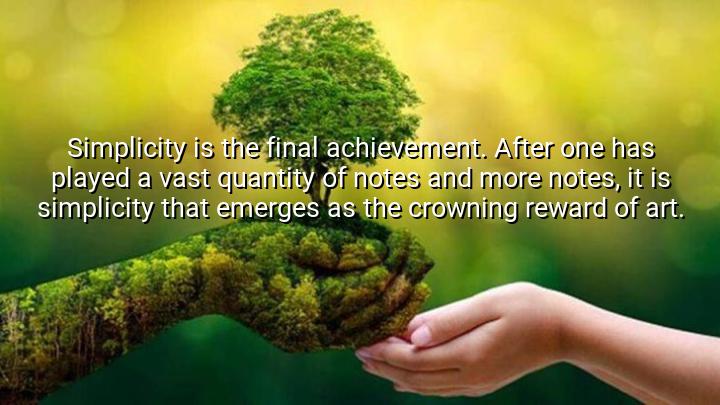




The quote "Simplicity is the final achievement. After one has played a vast quantity of notes and more notes, it is simplicity that emerges as the crowning reward of art" by Frédéric Chopin reflects the idea that art—specifically in the context of music—is ultimately about achieving a refined simplicity. Chopin, a renowned Romantic composer and pianist, is suggesting that after a long process of experimentation, learning, and technical mastery, the true essence of music lies in its clarity and elegance. This simplicity does not mean lack of depth, but rather the ability to distill complex emotions and technical skills into something pure, concise, and meaningful.
Chopin emphasizes that the journey to this simplicity involves playing and mastering a vast number of notes and techniques. As a musician, one might initially focus on the complexity of composition or performance, learning and executing a wide range of techniques. However, as one progresses, the ultimate achievement is the ability to express ideas and emotions in a simple, yet profound way. It’s a recognition that greatness in art often comes from restraint and the ability to convey powerful messages with economy of means.
The concept of simplicity emerging as the final reward also speaks to the idea of maturity in an artist’s development. When an artist has mastered their craft and fully understood the complexities of their medium, they can then simplify their work to its most elegant and effective form. Chopin’s music, for example, is often celebrated for its emotional depth achieved through relatively simple yet highly expressive melodies, proving that simplicity does not detract from richness but rather enhances it.
Ultimately, Chopin’s quote highlights the paradox that simplicity, often seen as easy or basic, is actually the result of great skill and experience. It suggests that the pinnacle of artistic achievement is not about adding more complexity, but about achieving the ability to express profound ideas through the most elegant and straightforward means. In music and in art, true mastery is about knowing when to simplify and distill one's vision to its most essential form.

NVDinh Nguyen Van
Reading this, I can’t help but think about modern music and how simplicity is often criticized as lazy or unoriginal. Has our perception of simplicity shifted? Do we equate more production, more layers, and more content with better art? Maybe we’ve forgotten how much discipline and insight it takes to say something profound without relying on embellishment.
LALucarta Arthur
This quote really flipped my perspective. I always thought virtuosity was about complexity, about showing off technical skill. But Chopin suggests that the real brilliance comes when you can say something powerful with less. I wonder how that translates across art forms—like writing, painting, or film. Does simplicity universally reflect deeper understanding, or is it more subjective than that?
HNHan Nguyen
This statement reminds me of minimalism and how difficult it is to do well. There's a fine line between simple and simplistic. Is the 'crowning reward' Chopin talks about more about emotional depth or technical refinement? I’m curious if simplicity in art speaks more directly to the soul because it leaves space for the viewer or listener to engage with it personally.
BKBRH K
I find this quote both inspiring and challenging. It makes me think of all the times I’ve tried to overdo my creative work, thinking more equals better. But is restraint something you can consciously learn, or does it only come with experience? How do artists know when they’ve stripped away just enough to leave only what matters most without making it feel empty or incomplete?
KDNguyen Khanh Danh
Chopin’s quote really resonates with me, especially in a world that often equates complexity with value. It’s fascinating how true mastery seems to circle back to simplicity. But I wonder—does achieving simplicity require first embracing complexity? Can someone truly appreciate the beauty of a single note without having explored a multitude? It feels like simplicity, in this context, is earned, not chosen from the beginning.