

Silence is one of the hardest arguments to refute.
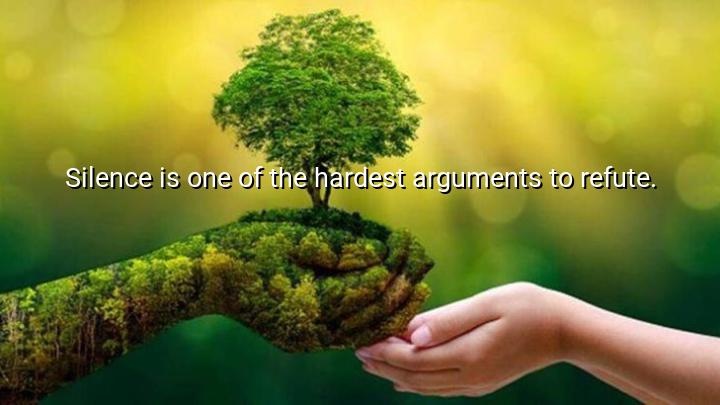




The quote by Josh Billings — "Silence is one of the hardest arguments to refute." — suggests that silence can be a powerful response in a disagreement or debate. When someone chooses to remain silent, it can leave the other party without a clear counterargument. Silence forces the opposing side to confront their own words and assumptions without any immediate rebuttal, making it challenging to continue the conversation or prove a point. In some cases, silence is more effective than engaging in a verbal argument, as it can indicate wisdom, control, or a refusal to participate in unproductive exchanges.
Billings, a 19th-century humorist, was known for his witty and often insightful commentary on human nature. His statement reflects the idea that silence can be a strategic tool in discussions, especially when words can escalate conflicts or distort the truth. By not reacting to provocations, a person may make it clear that they are not interested in arguing, thereby avoiding unnecessary confrontation.
The quote also highlights the idea that silence often speaks louder than words. In many situations, it forces the other party to reflect on their argument or to confront their own flaws. When someone remains silent, they may avoid getting drawn into unnecessary conflicts, allowing them to maintain emotional control and intellectual clarity.
Ultimately, Billings’ quote emphasizes the strength that can be found in silence during heated moments. Sometimes, choosing not to engage in an argument is the wisest response, as it leaves the other party with no easy way to refute your position or challenge your dignity. Silence can be a mark of inner strength and restraint, often more difficult to overcome than any verbal response.

-H-Binh HUYNH
I’m intrigued by this idea but also skeptical. Silence can indeed be powerful, but in some cases, could it be perceived as weakness or indifference? For example, if someone faces criticism or an accusation and chooses to remain silent, might that silence hurt their credibility rather than help? How does culture influence the perception of silence in arguments? I’d love to hear different perspectives on when silence is an effective form of communication and when it might backfire.
XTNguyen Xuan Trieu
This quote resonates deeply with me, as I’ve often noticed how silence can be unsettling or persuasive without a single word spoken. But does this imply that silence is always the best response in confrontations or debates? Could there be moments where breaking the silence is necessary for clarity or justice? I’m curious about the psychological mechanisms behind why silence is so hard to refute—does it create doubt, reflection, or fear in the opposing side?
VVThuy Van Vo
Reflecting on this quote, I feel a mix of admiration and caution. Silence can be powerful, but can it also be a passive form of avoidance? Is it ethical to use silence as a tactic in arguments to sidestep accountability or difficult questions? On the other hand, silence might compel the other party to rethink their stance deeply. How can one differentiate between silence as strength and silence as evasion in real-life interactions?
JWJii Win
I find this quote quite thought-provoking, especially in today's world where everyone seems compelled to respond immediately on social media or in discussions. Does silence truly serve as an unchallengeable argument, or can it sometimes be mistaken for ignorance or lack of ideas? Also, is there a risk that silence might be misinterpreted, leading to misunderstandings? It’d be interesting to explore contexts where silence strengthens a position versus where it weakens it.
UGUser Google
This quote makes me wonder: how often do we underestimate the power of silence in a debate or conversation? Sometimes, not responding can feel like conceding defeat, but could it also be a strategic way to avoid unnecessary conflict or to let the other person reflect? I’m curious if silence always carries weight or if its impact depends on the situation and the people involved. What do you think triggers silence to be so effective in communication?