

Revenge and retaliation always perpetuate the cycle of anger, fear and violence.
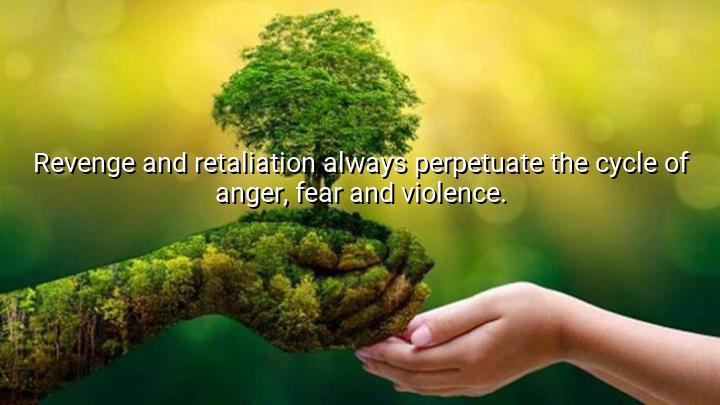




In this quote, Coretta Scott King highlights the destructive nature of revenge and retaliation, emphasizing that they only serve to continue a cycle of anger, fear, and violence. She suggests that seeking revenge does not bring about closure or healing, but instead perpetuates negative emotions and harmful behaviors. The desire for retaliation often stems from a place of hurt, but by acting on it, individuals only fuel the same emotions that led to the conflict in the first place.
King’s words point to the idea that violence and anger are self-replicating forces. When we retaliate, we contribute to an ongoing cycle that is difficult to break. Fear also plays a crucial role in this cycle, as each act of revenge or retaliation deepens the emotional divide, making individuals more fearful and mistrustful of one another. The longer the cycle continues, the harder it becomes to achieve peace or reconciliation.
The origin of this perspective comes from Coretta Scott King’s advocacy for nonviolence, a core value she shared with her late husband, Dr. Martin Luther King Jr. Throughout her life, she worked to promote peace and justice, particularly through the Civil Rights Movement. This quote reflects her belief that violence and revenge are counterproductive, and that true healing and progress can only be achieved through forgiveness and understanding.
Ultimately, King’s quote serves as a powerful reminder that revenge and retaliation only extend the pain and suffering in any conflict. To break the cycle of anger and violence, individuals must seek alternative solutions grounded in compassion, reconciliation, and a commitment to peace.

TMNguyen Tien Manh
This statement reminds me of the ongoing debates about justice versus vengeance. How do we balance the need for accountability with the desire to avoid perpetuating violence? Is there a way to achieve justice that breaks rather than continues the cycle? It’s a profound question about the nature of healing and societal progress.
HHai
The idea that revenge perpetuates fear and violence feels intuitively true, yet it’s challenging to practice. What cultural or societal factors encourage revenge over forgiveness? How do media and politics influence our perceptions of retaliation? This quote invites us to examine not just individual actions but also the environments that shape our responses to harm.
MNDai Minh Nhat
This quote underscores the importance of breaking the cycle of violence for peacebuilding. It makes me curious about psychological research on forgiveness and anger management. Can individuals truly let go of the desire for retaliation, or is it an innate human impulse? Understanding this might help design better interventions for conflict resolution.
KNLe kim ngan
Reading this quote makes me think about historical and ongoing conflicts where revenge perpetuates suffering. How do communities overcome deeply ingrained patterns of retaliation? Are restorative justice practices a viable path forward? It also brings up the emotional challenges—how do victims heal without seeking revenge, and how does society support them in that process?
VHnguyen viet hung
I find this statement very powerful, especially in today’s world where retaliation often seems like a default reaction. How do we cultivate the strength to resist the urge for revenge? Is it possible to teach nonviolent conflict resolution on a larger scale, and what role does education play? This quote encourages reflection on personal and collective responsibility in ending cycles of violence.