

Quite a lot of our contemporary culture is actually shot through with a resentment of limits and the passage of time, anger at what we can't do, fear or even disgust at growing old.
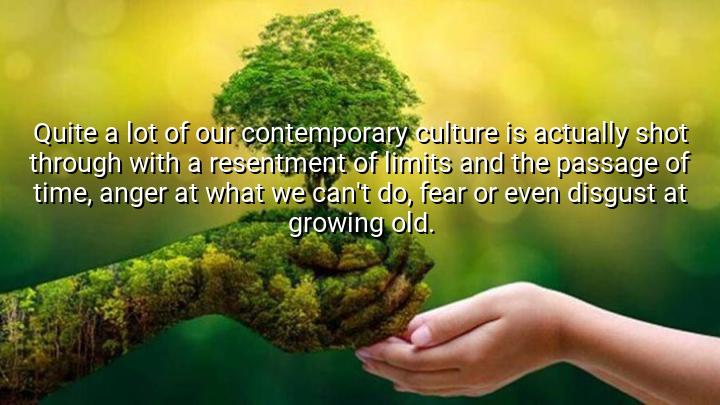




In this quote, Rowan Williams critiques aspects of contemporary culture, suggesting that much of it is driven by a resentment of limits and the inevitable passage of time. Williams argues that modern society often emphasizes a desire to break free from constraints, whether they are physical, social, or temporal. This resistance to limits can be seen in the relentless pursuit of youth, perfection, and the illusion of unlimited possibilities, which is prevalent in many aspects of culture, from media to technology.
Williams also points out that this resentment manifests as anger towards what we cannot change or achieve. This reflects a deeper dissatisfaction with human limitations, especially those imposed by aging and the finite nature of life. He highlights how anger arises from the frustration of not being able to overcome natural boundaries, particularly in a society that often glorifies youth and immortality.
The quote also touches on the emotional reactions of fear and even disgust towards growing old. In contemporary culture, aging is often seen negatively, associated with decline, loss, and obsolescence, rather than acceptance or wisdom. Williams suggests that these emotions are a response to the discomfort of confronting mortality and the fact that we cannot escape the passage of time.
Ultimately, Williams’ statement challenges the modern mindset that strives to transcend human limits. He urges a more thoughtful approach to the realities of aging and time, advocating for a cultural shift where we embrace rather than resist these aspects of life. By doing so, we might cultivate a deeper acceptance of our finite existence and a healthier perspective on aging and imperfection.

UGUser Google
This quote strikes me as both critique and call to reflection. Why is it so difficult for society to honor limitation without interpreting it as weakness? I think a big part of the problem is our cultural definition of worth—tied to output, youth, speed. What would our world look like if slowness, aging, and even failure were treated with respect instead of resistance? That’s a future I’d want to see.
HTManh Hieu Truong
Williams makes a great point about contemporary discomfort with the passage of time. But I wonder, is this a modern issue, or has humanity always struggled with aging and limitation—just in different ways? Maybe our tools have changed, but the emotional response is timeless. Still, the way we commercialize and medicalize aging today feels unique. Are we actually trying to overcome time, or just pretend it’s not happening?
TDTuan Duong
I feel like this quote reveals a deep spiritual crisis. When we reject aging and limitation, are we also rejecting humility? There’s something profound about accepting that life has stages, that loss and transformation are natural. Could our obsession with youth actually be making us more anxious and disconnected? I wonder if ancient traditions have more wisdom about this than modern culture tends to acknowledge.
QMQuynh mai
This is such a thought-provoking observation. I’m curious—does our resentment of limits come from a fear of death, or from the illusion that we’re supposed to be in control of everything? In a world driven by tech and convenience, anything less than instant mastery feels unacceptable. But isn’t limitation part of being human? Maybe we need to relearn how to live with fragility instead of constantly resisting it.
LTLoc Tan
Rowan Williams brings up a point that feels uncomfortably true. Our culture glorifies youth and productivity, but what happens to those who no longer fit that ideal? Is that why so many people feel invisible as they age? I’d love to see more celebration of the beauty and depth that come with growing older. Do we need to redefine success and value in ways that don’t expire with age?