

Photography is a major force in explaining man to man.
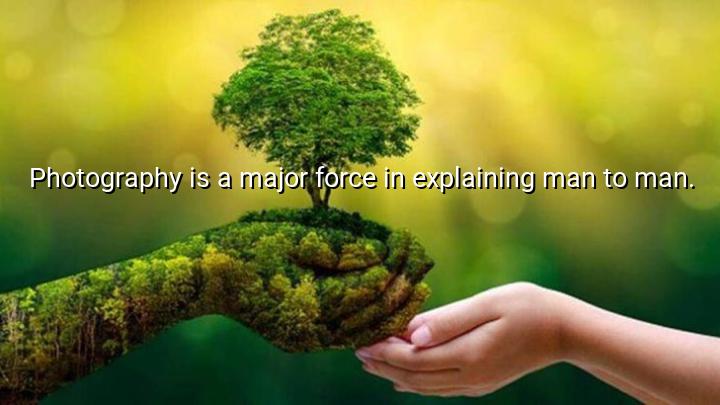




The quote "Photography is a major force in explaining man to man" by Edward Steichen highlights the powerful role of photography in bridging gaps between individuals by providing a visual language that conveys human experiences and emotions. Steichen suggests that photography, more than any other medium, has the ability to communicate complex aspects of the human condition—be it culture, history, or personal stories—making it a tool for understanding and empathy. Through photographs, we are able to see the world from others' perspectives, which fosters greater connection and understanding.
Edward Steichen, a renowned American photographer and curator, was deeply influential in elevating photography to an art form in the 20th century. This quote reflects his belief in the documentary and emotional power of photography. Unlike written or spoken words, photographs capture moments and convey messages that transcend language barriers, offering an immediate, visual connection that speaks directly to the viewer's heart and mind.
The origin of this quote lies in Steichen’s work as both a photographer and a curator at the Museum of Modern Art (MoMA). His famous exhibitions, such as The Family of Man (1955), showcased the universality of human experience, demonstrating how photography could communicate shared emotions and experiences across cultures and continents. Steichen recognized that photography had a unique capacity to reveal not only individual stories but also the common threads that connect humanity.
For photographers and artists, this quote emphasizes the idea that photography is not just about capturing images, but about telling stories and sharing the human experience. It encourages photographers to use their craft as a means of creating dialogue and understanding between people, helping to explain the complexities of life, emotions, and cultural identity in a way that words alone may struggle to do.

TATram Anh
This quote really resonates with me as someone who loves street photography. When I capture someone’s candid moment, I feel like I’m witnessing a truth they might not even realize they're expressing. It’s not about glamor or drama, but about connection. Yet I sometimes question—am I truly explaining ‘man to man,’ or just framing my own version of what I think that person represents? It’s an ethical and artistic challenge.
THThanh Hung
Isn’t it fascinating how one photo can reveal more about a person or situation than pages of writing? I agree that photography can connect us in a visceral, emotional way. But I'm curious—do we risk oversimplifying complex issues when we rely on images alone? A photo might evoke empathy, but does it explain context? Maybe true understanding still requires words, background, and dialogue in addition to the visual.
KCTran Le Khanh Chi
There’s something both comforting and haunting about this statement. Photography does bridge gaps between people, but it also exposes how different our lives and experiences can be. Does that lead to empathy or just voyeurism? I worry that we consume so many images now that we become numb to them. Can photography still serve as a meaningful force for understanding, or has it lost some of its impact in the digital age?
NBNguyen Luong Ngoc Bich
This quote makes me think about the role of photojournalism. Images from war zones, protests, or moments of peace often shape how we understand the world. But are we sometimes too quick to assume a photo tells the whole story? How much responsibility lies with the photographer to be honest and representative, and how much lies with the viewer to interpret critically? It’s a delicate balance of truth and perspective.
NMNhat Minh
I find this quote incredibly powerful. It makes me reflect on how photography captures the essence of human experience without needing translation. A single image can communicate suffering, joy, love, or injustice across cultures and time. But I wonder—does photography truly explain humanity, or does it just offer a snapshot, leaving the interpretation to the viewer? Can it ever be objective, or is it always colored by the photographer’s intent?