

Every other artist begins with a blank canvas, a piece of paper the photographer begins with the finished product.
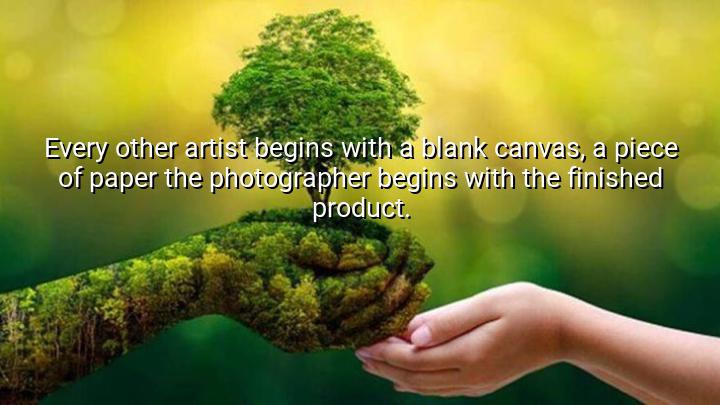




The quote "Every other artist begins with a blank canvas, a piece of paper; the photographer begins with the finished product" by Edward Steichen highlights the unique nature of photography compared to other forms of art. While traditional artists like painters and illustrators start with a blank surface and create their work from scratch, a photographer starts with an existing scene or subject, capturing a moment in time. In this sense, the photograph is often seen as a direct representation of reality, with the photographer’s role being more about capturing the right moment and composition rather than building the artwork from the ground up.
Steichen’s quote underscores the idea that photography is not just about creating but also about selecting and interpreting what already exists in the world. Unlike artists who use their imagination and skill to create a visual narrative, photographers work with the world as it is, framing and focusing on specific elements to bring out the artistic quality of the scene. The “finished product” is already present in nature or life, and the photographer’s task is to capture it at its most authentic or beautiful.
This perspective on photography also reflects Steichen’s own philosophy as a pioneer in photography. He believed that while photographers did not invent their subjects, they could still imbue their images with deep meaning and creativity. For Steichen, the process of photography involved careful observation and a unique ability to present reality through an artistic lens, using composition, light, and timing to create something more than just a snapshot.
Ultimately, Steichen’s quote points to the distinct role of the photographer in the artistic process. While other artists create from nothing, photographers start with something already present, transforming the world into art through their perspective and technique. This shift in how art is created and interpreted positions photography as both a reflection of reality and an artistic medium with its own set of challenges and opportunities.

MPQuynh Mai Pham
I love how this quote flips the creative process on its head. It makes me appreciate how photographers must have an eye for what's already in front of them—rather than creating it from imagination. But I wonder, does this mean photography is more about observation than invention? And if so, is that why some people still struggle to see it as 'art'? I’d love to hear from photographers on how they view this divide.
UGUser Google
This statement made me wonder about the pressure photographers might feel. If you're starting with a 'finished product,' does that raise the stakes for capturing something meaningful? Unlike painters or writers, you don’t build from scratch—you *respond* to what’s already there. Does this make photography harder in some ways, since you're always trying to find a spark of originality in a world that's already complete?
TNtuyet Nhi
There’s something a little elitist in this quote that bothers me. Is Steichen placing photography on a different level—or implying it’s less imaginative because it deals with the real world? I think this overlooks how photography can abstract, distort, and reframe reality in ways that are deeply expressive. Can't a photographer’s 'canvas' be every bit as fluid and transformative as a painter’s?
TNTrang Nguyen
This made me think—if the photographer begins with the finished product, does that mean photography is inherently more about *selection* than *creation*? I kind of love that idea. It’s like the art of knowing what *not* to include. But then again, post-processing exists too. So can we really say the image is 'finished' when the shutter clicks, or is that just the starting point for modern photographers?
DHNguyen Duy Hoan
I find this quote thought-provoking, but it seems to ignore how much control photographers actually have. Isn’t the world itself more like raw material than a finished product? A painter may begin with a blank canvas, but a photographer must choose *what* to capture, *how* to frame it, *when* to click. Isn’t that a creative process just as intentional—if not more immediate—than starting from nothing?