

Once an object has been incorporated in a picture it accepts a new destiny.
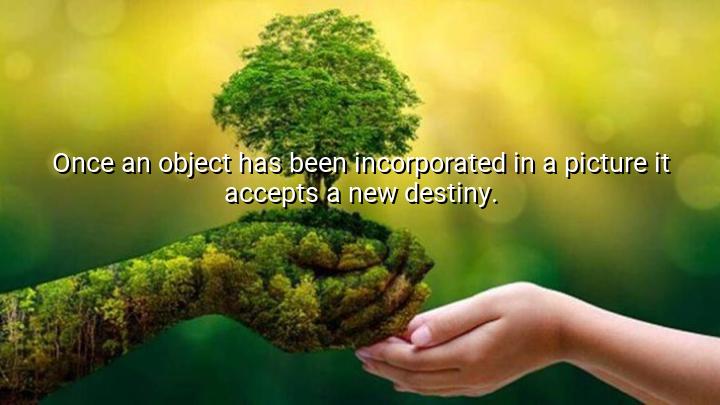




The quote "Once an object has been incorporated in a picture, it accepts a new destiny" by Georges Braque suggests that when an object is introduced into the realm of art, it undergoes a transformation, gaining new meaning and significance. Braque, a pioneer of Cubism alongside Pablo Picasso, implies that the act of including an object in a painting or artwork shifts its role from being a simple, physical entity in the world to becoming part of a larger artistic context. In this new setting, the object is freed from its original function and can take on new interpretations and symbolic value.
Braque, known for his innovative approach to form and perspective, believed that art could transcend the conventional understanding of the material world. By incorporating everyday objects into art, he sought to challenge traditional perceptions and explore how these objects could be perceived differently when placed within a painting. The destiny of an object in an artwork is shaped by the artist's vision, offering a fresh lens through which to understand both the object and the viewer's relationship to it.
The origin of this quote comes from Braque's work in Cubism, where he sought to break down traditional boundaries of representation. In Cubism, objects were fragmented and reassembled, inviting the viewer to see them from multiple angles and perspectives. This approach allowed the object to assume a new role within the artwork, one that was dynamic and open to interpretation. For Braque, the act of integrating objects into art meant that they became part of a new narrative that was detached from their original context.
For artists, this quote emphasizes the idea that the materials and objects they incorporate into their work take on new significance through the lens of artistic expression. It invites creators to reconsider how the ordinary world can be transformed and redefined through artistic exploration. Braque's perspective encourages artists to see their work as a space where objects are liberated from their utilitarian purposes and can take on new roles and meanings within the creative process.

TCTku Changg
This makes me reflect on the artist’s role as a kind of storyteller or even god-like figure. By choosing what to include in a painting, the artist doesn’t just depict the world—they actively change the object’s place in it. Is Braque saying that art creates parallel realities? If so, then every still life or portrait is more than representation—it’s transformation. That’s a powerful, almost spiritual idea, isn’t it?
BJBaek Jeong
I find this idea kind of haunting. When an object becomes part of a painting, is it being liberated from its original function—or imprisoned in a new one? There’s something a little unsettling about assigning ‘destinies’ to things. It implies a loss of original identity. But maybe that’s the whole point: that objects, like people, can be reborn in different narratives depending on where and how they’re placed in art.
MPThuy Mai Phuong
This quote gives me a kind of magical feeling. It's like art has the power to rewrite reality. But I wonder, is this new destiny fixed once it enters the artwork, or does it evolve with time, viewers, and cultural context? For example, a clock in a painting today might be about time, but in the future, it could symbolize obsolescence or nostalgia. How permanent is this so-called new destiny?
HVHien Huynh Vinh
I can’t stop thinking about this in relation to found-object art or collage. If you take a newspaper clipping, a bottle cap, or a feather and place it into a visual composition, is it really taking on a new life, a different purpose? Braque seems to suggest that art can transform even the most mundane item. That makes me wonder—can art also redeem forgotten or discarded things just by reframing them?
PVPhung Vu
Does this mean that the meaning or identity of an object fundamentally changes the moment it’s represented in art? I find that idea fascinating. A simple chair in real life is just a place to sit—but in a painting, it can symbolize loneliness, power, or nostalgia. Is it the artist who gives it that new destiny, or does the viewer play an equal role in reinterpreting it within a new context?