

Art is made to disturb, science reassures.
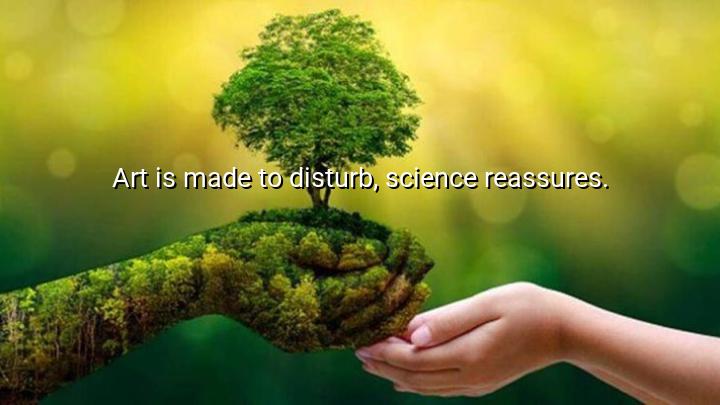




Georges Braque’s quote, "Art is made to disturb, science reassures," highlights the contrasting roles that art and science play in human life. Braque, a prominent French painter and a key figure in the Cubist movement, suggests that art is inherently disruptive—it challenges perceptions, shakes up the status quo, and provokes thought and emotion in ways that often leave the viewer feeling unsettled or unsettled. On the other hand, science provides answers and certainty, offering a sense of security and understanding about the world.
The phrase "art is made to disturb" reflects Braque’s belief that art should not aim to comfort or soothe but should instead challenge conventional thinking, explore new ideas, and confront the viewer with unfamiliar concepts. This is particularly true in the context of the avant-garde movements, like Cubism, which sought to break traditional artistic forms and disrupt the viewer’s perception of reality. Art, for Braque, has a deeper purpose than mere aesthetic pleasure—it is a vehicle for pushing boundaries and expanding the mind.
In contrast, Braque claims that "science reassures", meaning that science functions in a stabilizing role. It provides factual knowledge and rational understanding that helps people feel grounded and confident in their comprehension of the world. Whereas art stirs up questions, uncertainties, and new ideas, science seeks to resolve them, offering predictable and repeatable results that calm anxieties and bring clarity.
Ultimately, Braque’s quote speaks to the distinct but complementary roles of art and science in human experience. While science provides us with structure and understanding, art serves to disrupt and question, keeping the mind open and engaged in a continuous search for deeper meaning. Both are essential, but their functions are fundamentally different: one offers certainty, while the other invites transformation and growth.

VCPham Van Chinh
Reading this made me wonder about personal reactions. I’ve found comfort in both art and science, but also fear in both. Maybe the quote is more about traditional roles—art as expressive, science as explanatory. Still, it’s worth questioning: should we expect art to provoke us? What happens to its value if it doesn't? And is the reassurance from science always trustworthy, or does that depend on how it's used?
LLdo thi long lanh
This quote speaks to the tension between emotional and intellectual experiences. Art taps into emotion, often forcing us to confront things we’d rather avoid. Science, meanwhile, offers structure and explanation. But in today’s world, where science can feel politicized and art commodified, do you think the roles have blurred? Can we still say with certainty that science reassures and art disturbs? Or have the boundaries shifted with culture?
STHung Si Tray
Braque’s quote is fascinating because it suggests intention—art ‘is made’ to disturb. But is that always the artist’s purpose? Some artists want to uplift or inspire, while others aim to challenge. I wonder if the quote is more about how we *experience* art versus how it’s made. Do you think the disturbing nature of art is more about the viewer’s mindset or the creator’s intention?
MLMinh Le
This quote made me reflect on how I engage with both art and science. I seek out science when I want clarity and stability, but I turn to art when I need to feel something deeper—even if it’s discomfort. Maybe that's the beauty of both—they serve opposite but equally important functions. But I’m curious: has science ever reassured you in the same way a powerful painting or novel has?
BV44.Nguyen Huynh Bao Vy
I love how this quote challenges the way we think about creativity and logic. It makes me ask—should art always aim to disturb or question norms? Can art still be meaningful if it’s pleasant or reassuring instead of provocative? And when science shakes up what we thought we knew, does it still fall into the ‘reassuring’ category? I’d be curious to hear others’ interpretations of where that emotional line is drawn.